Monday, August 22, 2022

Trip to Portugal Day 1: Backroads to Obidos


Day 2 comes in two parts.

Frankfurt has an airport.

Part 1.  Still in transit. We land in Frankfurt around 10:10am local time, disembark, and spend an hour walking our way through passport controls, terminals, and security checks. The most exciting part of this stage is the total search I was subjected to by a security agent who pretty much shoved his hand down the front of my pants and then down the back.  Looks like Germany has a very different understanding of personal space.  

The plane was about 30 minutes late to leave, which gave us a chance to grab a coffee and a pretzel, because when in Germany - even if "Germany" = "Frankfurt Airport", you get a pretzel.


The Pretzel. It was decent.

Boarding the flight involved being bused to a very different part of the airport, which gave me a chance to take a picture of the terminal from the outside.

Frankfurt Airport Terminal A from outside.

Eventually we got to a place where our plane stood, and boarded it.

Our ride to Portugal

This took place in the middle of California night, so we tried with some moderate success to doze off on the ride. Still I was able to catch some nice scenery - the Alps, the Mediterranean Coastline, and a really nice approach to Lisbon.

 
The Aqueduct, as seen from the plane descending on the Humberto Delgado airport.

With this, we arrived to Lisbon, where Part 2 starts.

Part 2: Day 1 proper.   Getting off the plane was easy, no more passport control, since we are inside the EU. Spent some time waiting for luggage. Discovered that the Tile app and Tile devices we put on our bags don't work quite one would want them to work - you can find out where the Tile tag is only if another Tile user is within bluetooth reach of the tag.  At a starting point, my colleagues teaching computer security are right around now crying. Second, the one time you really need this feature is upon arrival to a new airport  in order to determine that the luggage arrived with you. Except that there are not going to be any Tile users on the landing field (except for the airplane passengers, but it looks like the luggage is stored in a way that does not allow for bluetooth signals from the main cabin to be transmitted to it. Eh, well. The bags still arrived.  

After taking a bathroom break we went outside to wait for the shuttle bus to the car rental place.


The shuttle came right around the time I started wondering. Took us to the rental place. At that point, things started to get - if not sour, then at least - dark comedy.

So, our car rental company is OKMobile. The rental itself is made through a broker.  Here are some things.
  • One week before our trip, I get an email saying "in order to speed up your reservation, please complete these forms". The forms ask for driver's license and passport information. I enter the info, receive confirmation that I am good to go
  • I also receive an email that we ABSOLUTELY MUST HAVE International Driver's Permits.  I call their office and ask "I am a resident of the US, I have a US driver's license, do I need an IDP", and I get an unequivocal "YES, YOU DO". So we go and pay $60 for two IDPs with photos. Better safe then sorry.
  • Upon arrival to the rental place, of the three people there, we get the Incompetent Newbie.  
    • This appears to be the first time he saw a US driver's license.  
    • He asked us for licenses and "IDs", and I had to ask him three times "what other type of Id would you like" before we got to "Passport, please". 
    • We NEVER had to show our IDPs. 
    • He spent 30 minutes re-entering our passport and license data THAT I ALREADY PROVIDED to their system.
    • To cap all of it, he took us to our car - a rather unexpectedly large Renault Kadjar (we asked for an automatic transmission, apparently these are the only automatics they have). We spend 10 minutes going over the scratches on the car. The car is parked in a way that makes it hard to pull it out, so we ask him to pull out the car. He gets in the car, and hits another car standing nearby.


The car he drove got some surface scratches, but the other car got a dent.  Took him another 25 minutes to change paperwork and give us another car.  All of this mildly annoying because the entire time spent at the rental place that was empty when we arrived was about an hour and forty five minutes, when it should have been no more than 30.  But also, dark comedy gold.  Most of it is just the real lack of experience, and personality traits that are not conductive of working customer service jobs, but I sincerely hope that the guy does not get fired or docked a lot of pay for denting a car on the lot.

So, we get our car (this is it below, pictured in its resting place for tonight), and start the drive to our first stopover, Obidos.  Except, after verifying that the car indeed has the Via Verde (toll road) tag that allows us to travel the toll roads and not worry about tolls, I find out that my google maps is set up California-style to "avoid tolls" setting. This becomes apparent only about 20 minutes into the drive when we leave the major highway behind and start taking backroadiest of the backroads.  


The good news: it's a nice scenic drive - much more fun that driving on a divided highways with tree cover on both sides. We get to drive through countless small villages, take cobble road detours, go up and down several hills in a somewhat see-saw fashion, and see a lot of the back country that definitely is not tourist territory.  We also pass by a Lidl and take immediate advantage of it.  Wasn't even sure where we were, but found it on the map post factum, it is the store in Arruda dos Vinhos - one of the small towns/large villages we passed through.


Eventually, as the sun drops below the horizon, we make it to A8, which apparently is free on its approach to Obidos, and take it for the last leg of  today's trip. We drive up a narrow driveway leading to our Airbnb to meet our landlady, who's been texting us since about 3pm (it is not 8:30). I roll the car up and through a vary narrow turn to reach the upper parking spot, where we rest the car as you see it above. The parking spot is adjacent to the back door to our place which leads to a nice patio, and our bedroom. There is a spiral staircase leading downstairs to the living room and kitchen.  


We thank our landlady, who left us some cheese crackers and a bottle of wine in the fridge, and unpack. After a quick shower that each of us desperately needs, we throw together a late night meal of bread, sausage, cheese, seafood and olives, and wash it with some wine.  We are officially done for the day, which has proven to be somewhat uneventful, but very long.


Today's wine. 
1.  Papa Figos Douro Branco 2021


Grabbed this one for Olga out of the fridge at Lidl. For 3 Euros, this is a great refreshing white. I expected something bone dry and instead got some sweetness to complement the bright acidity. Olga, who typically does not care for sweetness in her wines, interestingly enough quite liked it as well.

We'll give it a score of A-

2.  Paco Do Bispo Moscatel De Setubal DOC 2019


Also bought at Lidl for something like 3.99, primarily because (a) last time I brought a bottle of Moscatel and waited for a while to try it, now I want to have a bottle available for the entire trip, and (b) for the name, which includes allusions to both major AVAs in San Luis Obispo county (Paco = Paso, Bispo = Obispo).

Exactly what I expected - smooth, sweet, with little acidity, but easy to drink. Totally worth it for those who like dessert wines.  B.

Steps. 6589 according to Google Fit (watch reset before I was able to see, but had a consistent number last I remember). Mostly traversing through airports.

Tomorrow.  Walking tour of Obidos, and Obidos castle.  


Trip to Portugal Day 0: Getting off the ground...


A very short day. Got a ride to SFO, went through ticketing, passport control, security check, and boarded the plane to Frankfurt.  The only interesting bit about this part of the process was that at boarding time our Lufthansa took our pictures, but did not ask for boarding passes at all. 

Short flight overview.  We flew in a 2-story Boeing 747. Don't know what is located upstairs - did not get to see it, but this plane has by the looks of it about as many first class and business class rows as it does economy rows. We sat in economy rows in the middle isle close to the back of the plane - the cheapest seats on the plane.  

Good things:  Checked-in luggage and carry-on (our fare included them), two meals, drinks including wine and beer, nice movie catalog.

Bad things: probably the narrowest seats I've sat in on international flights over the past 10-15 years.  It's not even the leg room per se - although also nothing to write home about - it is the width of the seats.  10 seats per row will do it.

Waiting at the ticketing.


For the most part I took advantage of the movie catalog and got caught up on several Marvel movies. The full list:


* Bill and Ted Face the Music: B: nice, but could be better.

* Spiderman: Far From Home: B:  some nice moments, otherwise, just checking the box

* Eternals: B:  I have a feeling all my MCU movie reviews are going to be in the B range - professionally made movies that use the tropes that I don't necessarily care very much for.

* Spiderman: No Way Home: B+: I know that there was a lot of hype before the release of the movie, I wound up reading a lot of analysis of released trailers, and predictions. Seems like every single prediction came to be, which makes me wonder if those were not predictions at all, but rather leaks carefully pretending to be predictions. Anyways, I like Toby McGuire, and he is good in this movie.

This is pretty much it, arrival to Frankfurt marks pretty much the beginning of Day 1.


Steps: around 3000 according to my watch. Hard to know exactly, as the watch reset in the middle of the flight, but 3000 is a good estimate.

International Terminal at SFO has an outside viewing area.

Next Day:  fly from Frankfurt to Lisbon, get a car, drive to Obidos, stopping on the way at a Lidl store.


Saturday, August 20, 2022

Trip to Portugal: Day -1


Packed the bags, loaded up the car and went to San Jose. Our flight is tomorrow. Today I managed to visit the revival meeting of Ignite: no longer Cal Poly, now Bay Area. 

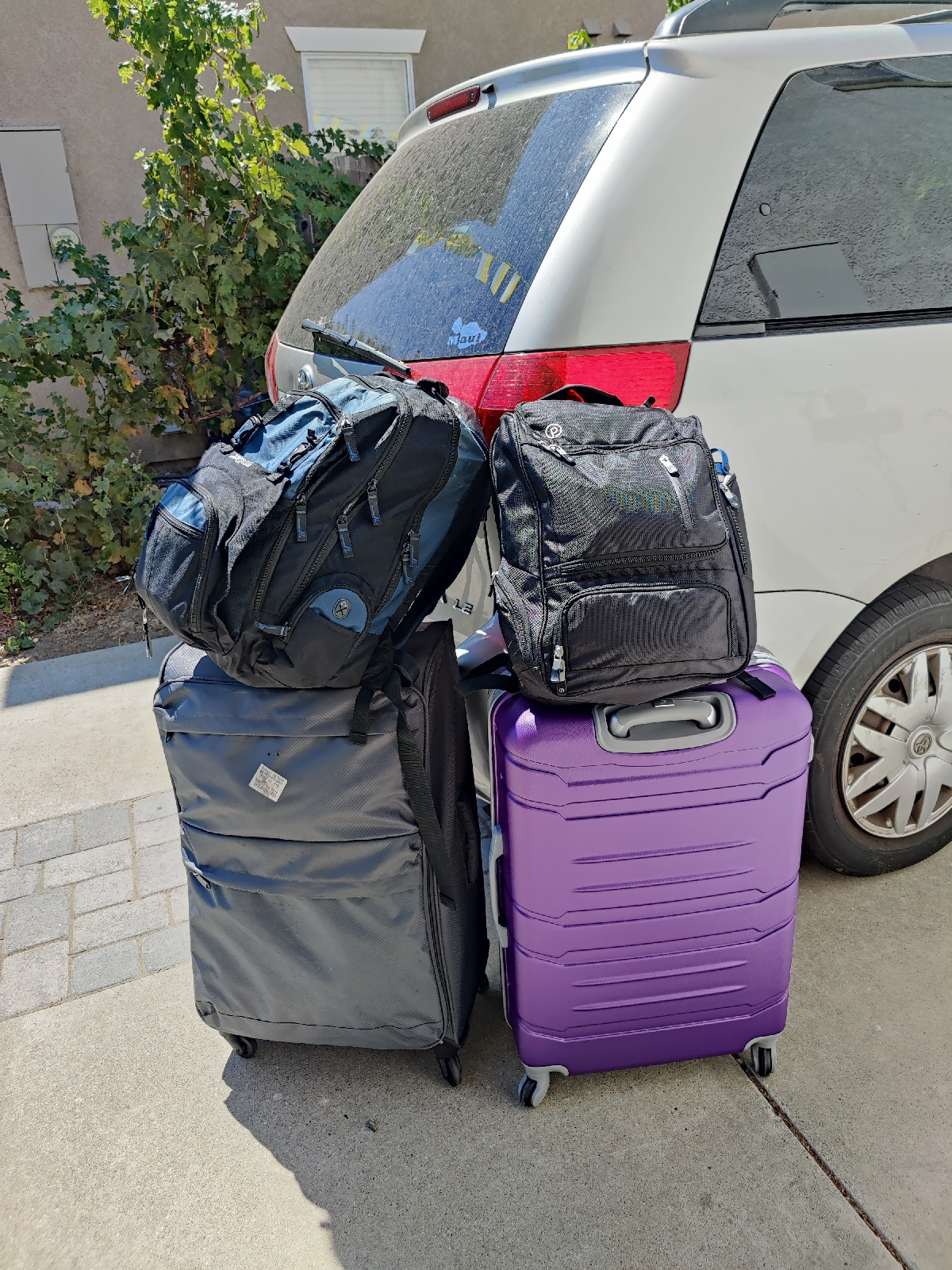
Not much else to report.

Steps: 4243 according to my watch, most of them probably running around the house packing.

Tomorrow: flight to Frankfurt, then onto Lisbon, renting a car, driving to our first place in Obidos. 

Wednesday, August 17, 2022

50!

 Just a short note.


A. I turned 50 today. Yay.


B. Our first overseas trip since COVID is coming. August 22 - September 8 we are in Portugal (the photo below is from our 2017 trip).


I plan to post daily updates here - we'll see if I am successful.  First five days we stay in Obidos with the goal of seeing the central part of Portugal. Then - five days in Porto, with possible day trips to Douro and Braga. Finishing it off with four days in Lisbon to recapture our 2017 experiences.

One year of playing with cheap pedals: a beginner's review. Part II.


Today is Part II of the overview of the pedals. It concentrates on the overdrives, that occupy the lion's share of the pedalboard.

Part II. Overdrive, Distortion, and Fuzz Pedals.

10. Dolamo Overdrive


Provenance.  Amazon. Was part of the first batch of pedals I bought during the Thanksgiving sale in 2020.

Cost.  Somewhere around $20-22.

Category: bargain basement budget

Review.  This is a very mellow overdrive pedal. Originally it sat at the beginning of a chain of my overdrives,  although with time some new pedals were placed in the middle row of the pedalboard and in front of it (note the picture above is of the new pedalboard configuration and place it at the beginning of the chain of drives again).  

For several months I had gain at 9 o'clock, bass at around 9 o'clock to noon, treble at close to max, and level to bump up the over all volume a bit. In this configuration it is a nice clean boost with just a tad color and saturation added to the signal - it works really well with most clean channels of my amps, and is a great sound for laying down rhythm guitar on a loop. With time I learned to warm up the sound by dialing the treble off a bit.  I still prefer using this pedal on low gain settings. On higher gains it goes into a plausible crunch, which is not unpleasing to the ear. On my pedalboard though I have plenty of crunches and not enough clean boosts, so the Dolamo overdrive has the default role of being the one pedal on when I need a clean sound that enhances the signal coming from the guitar.  It does this job really well.

Difficulty of use:  Easy. Low gain - essentially clean boost, higher gain - crunch. Bass and treble are responsive and can be easily kept around 12 o'clock if one wants to just forget about them. Level is not too powerful - I can get it close to max (on my standard amp volume setting) and not crash anyone's eardrums -  "gradual" is probably a good word to refer to it.

Rating: 
 A. I don't know what overdrive this is based off of, but it is a very useful pedal on my board - and it is keeping its relevance and holding its own in the presence of everything else that I piled on the board since.

Verdict:  Keeper.


11. Kmise Ultimate Drive Overdrive


Provenance.  Amazon. Same batch as the Dolamo pedal.

Cost. $25 or thereabouts.

Category: Bargain basement budget.

Review.  For several months this was the most high-gain pedal the board. It is ... capricious.  I've had situations where I was able to coax some of the purest, most "very rock! wow!" tones from it - both by itself and in combination with Dolamo placed in front. I also had produce very unpleasant and unbalanced tones.   

To start with, I would recommend anyone trying to use this pedal to start at close of minimal gain, and put the switch (I am assuming it is a clipping diod) on low, and just try to manipulate it to the edge of breakup zone.  This is not that difficult to do and the sound is full and rich, and nothing like any other drive/distortion pedal I have, although  the sounds it makes are sorta "classic rock"-ish and are quite recognizable. I play a Yamaha Pacifica with a homebrew pickguard that contains a Blacktop Filtertron in the bridge position, a TexMex Fender middle pickup, and Wilkinson neck pickup), and I think it reacts better to the single coils than to the Filtertron.  It also goes much better with some form of reverb, the dry sound is a bit... well, dry, although it is less of an issue with edge-of-breakup settings.

Unfortunately for this pedal, edge of breakup is not what I needed it for - as I mentioned, this was the highest gain pedal I had on the board for somewhere close to 8 months.  As a result I had to figure out the combination of volume and gain that would work well with my guitar. Such combinations exist, but they are affected quite a bit by other things in the chain: EQ, Compressor, delay, reverb.  This pedal can be very loud if one does not control Level when moving Gain up. I typically max out the tone, as it get s too dark very quickly when the Tone knob is moved counter-clockwise.

One last thing to note is that this pedal is where I learned to control the tone with the guitar's volume knob - lowering the pickup volume definitely cleans up the tone and most of nice tones I produced from this pedal were with my guitar volume at around 50% or lower.

Difficulty of use:  Moderate.  As discussed above, some care is required, but it definitely has several sweet spots that would work.

Rating: 
 B-. Perhaps a full B, but I wind up using this pedal less and less, especially now that I have some other high gain options, so, my playing habits are perhaps the best way to assess it.

Verdict: I am keeping it on the board for now, but this is probably the #1 candidate to be removed from the board, or moved to my office board, as it is largely redundant on the board at the moment. 


12. Iset Dumbler Overdrive


Provenance.  Amazon. Bought at the end of 2020.

Cost. About $25.

Category: bargain basement budget.

Review.  It says "dumble"! Wow!  What a bargain!

I don't know how a Dumble amp sounds (youtube videos compared to a pedal on own board do nothing to answer this question), but I am pretty sure, it ain't it.  Having said this, though, this is a great and very versatile pedal with a range of tones, and a unique voice.

Unlike the Kmise Ultimate Drive,  the Dumbler, which spent most of its time on the pedalboard right in front of the Kmise pedal, has been used in a wide range of tonal settings.  The beginnings, however are the same - max out the Tone and the Voice knobs (the latter is an interesting mid-frequencies EQ), put the Gain at 9 o'clock and adjust level. This creates a nice clean-to-edge of breakup sound (depending on the pickups and the gain setting of the amp), and this tone alone is probably worth the $25 this pedal cost me.   

It however does have quite a bite as well. Adjust the Gain up, and past 1 o'clock we are in a pretty serious overdrive zone.  I never liked maxing out the gain on this pedal, but if I want a pastiche on classic rock tones, taking the Gain to 3 o'clock does the trick quite nicely, as long as the volume is adjusted. Just as the Ultimate Drive, the Dumbler is responsive to guitar volume changes, although I often forget that I have this option of controlling the tone.

With time, like with many other pedals, I learned to roll the Tone and the Voice off. The setting pictured on the photo is pretty much what I am using now - sometimes rolling the Tone down to 12 o'clock.

Difficulty of use:  Easy. It might take some use to dial the exact tone one wants, and the Voice control is different from the EQ controls on other overdrive pedals, but finding a nice tone is pretty easy.

Rating: 
 A-. It gets a minus because I don't use it as often as I do some other pedals. But every time I turn it on I keep thinking "I should use it more".

Verdict:  Keeper.

13. Mosky/Musiclady Golden Horse Overdrive


Provenance.  Ebay. Bought at the end of 2020, I think

Cost. $23-25. The one time Ebay was cheaper than Amazon by a few bucks.

Category: bargain basement budget

Review.  Well, it's a Klon clone, perhaps one of the cheapest on the market. I have used it in a variety of ways - in front of other overdrives/distortions, at the end of an overdrive chain, with gain up, with gain down.  Not all combinations were successful, but most recent uses - turn the gain down, volume up, hit another pedal with it, gave me a really great boost.  In general, I think I rarely use it all by itself (even with the gain up) - usually teaming it up with several other pedals: like the Dolamo (my other clean-ish overdrive), or the Lumberjack (see below). It also works really well as a boost for the King of Kings.


Difficulty of use: Moderate. Not because controls are sophisticated, but because the range of tone options requires careful choices. Boost use is more or less obvious, but upping the gain requires more care.

Rating: 
  B+: really nice to have, growing on me.

Verdict: keeper. 


14. Caline Tantrum Metal Distortion


Provenance.  Amazon,  late 2020

Cost. $29

Category:  bargain basement budget

Review.  Wow - 29 bucks for a pedal with TWO switches (my only such pedal until the King of Kings)!  I do not begrudge myself buying it at that price. But at the end of the day, this is not really a good pedal for me.  For starters, with anything resembling a reasonable gain, this pedal is really noisy, and the noise gate has a hard time keeping up. The boost only works when the main distortion is engaged - which is unfortunate - I would have kept it on the board if the boost was independent. The tone, as far as metal tones go is ok, but nothing particularly exciting. Muza FD55 (see below) makes this pedal completely redundant on the main board.

Difficulty of use: Moderate. I mean, it sounds pretty metal even with gain most of the way down, but calibrating metal pedals is not my strong suit.

Rating: 
 C: works as advertised, but needs a different audience.

Verdict: Off the board.


15.  Playwell British Distortion


Provenance.  Amazon, some time in early 2021

Cost. $15

Category: bargain basement budget

Review.  Ugh.  At 15 bucks for "british" and "distortion", I figured that I'd take a plunge. The result though is rather disappointing. It sat on my board for a while because (as I stated in my Amazon review), I found one set of positions for Level, Gain, and Tone that created a decent tone distinct from any of my other tones on the board.  One set. Move the knobs just a bit, and the tone stops being decent to my ears.  To boot, the Tone knob is all but useless - move it just a bit off the Max position, and lose ALL the treble immediately. No range at all. Higher gain settings yield unpleasantness to my ears. Perhaps it is a proper rendering of the "British" distortion sound, but I just don't like it that much.

Difficulty of use: Hard. It is hard to find a good tone.

Rating: 
 D-: do not buy.  I don't know if this is just Playwell, or ALL "british distortion" budget models from all manufacturers, but this particular pedal is not a good deal even at the measly $15. There are better bargain basement pedals.

Verdict:  Off the board

16. ENO Blues Overdrive

Provenance.  Amazon, 2021

Cost. $29, but received a $10 discount.

Category:  Bargain Basement Budget

Review.   I wrote a bad review of the ENO's envelope filter pedal, and received a "sorry you did not like it, here is a $10 coupon" note from them. I decided to give ENO another try and bought their blues overdrive pedal.  Interestingly enough, the one I received looked different than the Amazon picture - it looks like two batches were made and they colored them differently. 

This is the only ENO pedal (I have three) that sounded reasonable.  There is a nice range to tone and gain. On low gain, I can get anything from icepick (with tone set to max) to pretty warm sweet blues (tone below noon, neck pickup). Higher gain is not as useful, I think, but overall, using this pedal was fun.

Difficulty of use: Easy. Lower gain, control Tone, win.

Rating: 
 B

Verdict: Off the board: at the time I had too many low-gain overdrives on the board and needed one overdrive pedal to move to a separate pedalboard. This seemed both somewhat duplicated (Dolamo does similar things, for example), and somewhat versatile to fit the bill. So, it went off the main board.  


17. Caline Pure Sky Overdrive


Provenance.  Ali Express, June 2021

Cost. $25.

Category: Bargain Basement Budget 

Review.   My first Ali Express pedal purchase. It was basically an "I can take it or leave" purchase, but Ali Express delivered it rather speedily. A really nice transparent overdrive, which, on low gain settings can be easily used as a boost.  I tried it both at the beginning of the overdrive chain, where I mostly used it to boost other overdrives, and at the end - where it is sitting now. I am using this pedal a bit less now, but it this pedal doesn't really have too many "bad" spots. Occasionally I turn it on all by itself to play "loud clean".

Difficulty of use:  Easy. You get nice tone from pretty much any meaningful position.

Rating: 
 B: probably closer to B+, but I am not using it much.

Verdict: keeper.

18.  Behringer Vintage Tube Overdrive TO800


Provenance.  Sweetwater, late 2020

Cost. $19.

Category:  Bargain Basement Budget

Review.   When the entire line of Behringer pedals goes on $19 sale, and you don't have a tube screamer, you buy a $19 tube screamer.  You get a very nice tube screamer. I can definitely make it work all sorts of things - from a pretty overdriven sound, to barely audible overdrive. It definitely sounds unique compared to all other overdrives on the board, and thus,  it earns its keep by providing nice alternate tone options. Even though it is kind of  made redundant by the Muza distortion pedal (see below), I like using it for tube screamer sounds over the Muza. I also like on occasion to double up on the tube screaming and run this pedal into the Muza in tube screamer mode.  Gets a bit noisy, but not too bad, and the tone becomes quite rich and saturated/distorted.

Difficulty of use: Easy. What you see is what you get - dial anything you want - it'll sound like a tube screamer.

Rating: 
  B. Solid.

Verdict: keeper until I decide to get a different screamer clone - which might not happen for a long time.


19. Electro-Harmonix Lumberjack Log Overdriver


Provenance.  Reverb, 2020.

Cost. $45

Category: vintage 

Review.  I was looking for a boost pedal, and wound up spotting this one and decided, heck, I can buy a real Electro-Harmonix pedal for a measly 45 bucks? How cool is that!  On a more serious note, I was attracted by the unusual nature of the gain (log growth), and the presence of a separate volume and boost knobs (with the noticeable absence of tone).  Youtube videos made is sound like a rather obscure pedal, so I went ahead an bought it. 

To my surprise, it is actually a nice pedal with a lot of range. Lack of tone is a bit unfortunate (I tend to correct its tone with an EQ pedal), but boy does it go from clean to dirty with ease and with a lot of different options. Low gain (log) with boost up and we have a mid-boost, which stays clean. Raise the gain, and you can have as much dirt as you want.  I typically hold it on clean-ish settings, and use it as one of the three go-to clean tones on the board.

Difficulty of use: Moderate. Log control needs some getting used to. 

Rating: 
 A: yeah, I know it's an obscure pedal from a manufacturer that does not even notice it. I still love it.

Verdict: keeper. The only way it moves off the main board is if I ever make a vintage pedalboard.  

20.  VSN Plexion Rocker Overdrive


Provenance.  Amazon, November 2021

Cost. $29.

Category:  Bargain Basement Budget 

Review.   Black Friday/Cyber Monday deal. Wanted a plexi overdrive. Chose this one over several others based primarily on the warpaint.  This purchase came before King to Kings.  In isolation, this is a great saturated overdrive pedal. Short of the Muza distortion models, this is probably the heaviest overdrive I have on the main board (Kmise US Dream is another candidate here).  While the pic above shows it in "Bright" mode, I prefer "Normal" mode, and then roll down the tone a bit for warmer sound.

King of Kings made this pedal a bit redundant - at some point I was switching between one side of King of Kings and the plexion, and they sounded almost indistinguishable to me.  


Difficulty of use: Easy.  Pick the gain. Go.

Rating: 
 B: nice pedal, it is not its fault that it is close to redundant

Verdict: keeper. For now. If I need space on the board for a more exciting overdrive, this may be the first one to go.


21. Muza FD55 Distortion M+


Provenance.   Ebay.

Cost. $18 pedal + $10 shipping.

Category: Modeling. What little I know about the maker (a Dutch company that released a series of modeling pedals including distortion, reverb and delay) is from a couple of web pages, and one or two youtube videos I was able to find.

Review.   Yes, ladies and gentlemen, I bought a distortion pedal with 10 different distortion/fuzz models, including Distortion+, Rat, MuffFuzz and MetalZone, and with six presets, for less than the what the Plexion cost me.  And yes, this is a modeling pedal, but this matters less than the fact that this pedal just rocks.  I bought it at the time when I was coming to a realization that I could use some Distortion+ or Guv'nor style saturated/compressed/clipped distortion pedals on my board, and was looking for one representative of the genre that would not be embarrassing. Instead I got the entire genre in one box.

Purists will probably scoff, but screw that. This pedal sounds amazing even on the settings on which it should not.  It can get loud and rough around the edges, so some care with the settings is required, and this is especially true if one wants to switch from one model to another on the fly - the change in tone is nothing compared to the change in volume (different models have different controls engaged). But I was able after a bit of tinkering to tame every single model (even the DOD FX86 DEATH METAL (tm) model which should only exist in nightmares).  Three models stand out: the Tube Screamer model is more fun to play than my dedicated Behringer clone (although I sometimes wax nostalgic and play the Behringer pedal just for kicks). The Distortion + model is rich and creamy, and easy to control, thanks to just two knobs. And Rat is my go to for this pedal.

The interface is complex, but the UI/UX design my the folks at MUZA is top-notch. For each model, there are up to six possible controls, and the LEDs show which controls are used with the currently selected model.  The dynamics are great and so is the range of tones - both within single models and between different ones. Somehow the three metal pedals all manage to sound very differently, justifying their inclusion (although I would have preferred a Guv'nor model).  

The pedal also has six presets, which the previous owner set to some fairly nice sounds, including a couple of low-gain, edge-of-breakup options that are among my favorite tones out of this box. 

Difficulty of use: Should be Moderate (lots of controls), but the awesome UI/UX makes it Easy.

Rating: 
 A+.  Best bang for the buck save for my first looper, perhaps.

Verdict:  Keeper. One of two anchors of the entire drive section of the pedalboard.


22.  Joyo King of Kings


Provenance.  Amazon

Cost. $69

Category:  Budget, clone.

Review.  I was both Bluesbreaker-curious, and, upon learning about Analogman - curious about that specific pedal as well. Was looking at some outright rip-offs from DemonFX and LYR, when I spotted this new Joyo pedal.  When it appeared on Amazon for the same price I saw on AliExpress, I pounced.

This is the most recent acquisition, and the ostensible reason why the pedalboard was rebuilt - the gap in the first row between the MUZA and the Blue Sky is the space left of the King of Kings. This is an awesome pedal, and a great and versatile choice.

At the outset (diode clipping switches down, tone midway, Gain at 11 o'clock) each individual half of the pedal sounded very much like my VSN Plexion. Which makes sense given the provenance of the ideas behind both pedals.  However, with both sides engaged, and with clipping diods on, the tonal range of this pedal far exceeds everything else I have, except for the MUZA, which isn't a fair comparison anyway, as it is a modelling pedal.

Figuring out this pedal takes a bit of time, but the good news is that there isn't a single bad tone in it - pretty much any setting, with pretty much any pickup combo on my guitar, with pretty much anything else on the board (I usually use some warming EQ, reverb and delay, I also added the compressor for this pedal to some nice effect) it produces really sweet and playable tones.  

Both Gain and Volume controls are gradual,  "on the side of caution", which means that 12 o'clock Volume and 12 o'clock Gain are not too loud or too distorted respectively.  Tone plays really nice with them, and in the vein of my recent attempts to play warmer sounds, it rolls off nicely, taking the edge off the most biting treble in the tone with ease.

Where things require some understanding and experimentation is with (a) diode clipping settings, and (b) playing the two halves together. 

Diode clipping settings. One thing to recognize (thank you, Josh Scott!) is that the clipping diode settings are not going to change anything until the pedal is actively distorting the signal. So, on low gain settings, there is not difference whatsoever between the four possible positions of the clipping diodes. It is when the gain is ramped up to close to max, when flipping the feedback switch (#2) produces a compressed distortion, and flipping the clipping switch (#1) saturates the signal, although without falling into the "scooped mids" territory.  Moving both switches into the "up" position turns King of Kings into a full-blown distortion pedal, albeit with some dearth of lows.

Pairing the two halves of the pedal. I've had several setting combinations where each half of the pedal by itself is quite loud, but turning both on results both in enhanced distortion, but also in a drop in the volume of the sound - so there is a definite compression effect at play here.  To properly operate both halves at the same time, I first set both halves to the same settings, and then adjust the behavior of each half to my liking, but gradually. I like keeping one half with diodes in the "down" position, and one half - with diodes in the "up" position, and high gain to turn them on.

Difficulty of use:  Moderate. The most sophisticated overdrive pedal I have, requires definite experimentation to get the sounds one likes -  especially in the part where the diode clipping settings start making sense.

Rating: 
 A+. A huge boost (no pun intended) to my pedalboard.

Verdict: Keeper. The other anchor of the drive section of the pedalboard.

23. Sonicake Fuzz


Provenance.  Amazon, 2020

Cost.  $29, I think

Category: Bargain Basement Budget

Review.  Somewhat of the testament to this pedal is that this has been my only fuzz, and I don't necessarily feel compelled to buy another one.  Of the two Sonicake pedals, this is the winner.  Great range of fuzz sounds, fuzz that sounds really good in a mix (when I play with the looper pedal with like 2-3 guitar overdubs), fuzz that can be both gentle and powerful.

I have experimented with a variety of uses - boosting it with other pedals, combining it with the octaver, or boosting another overdrive with it.  Each time, the sound, while not necessarily something to use every day, was impressive.


Difficulty of use: Easy.  Fuzz knob does all the work. 

Rating: 
 A.  Not using it often, but it's a quality pedal.

Verdict: keeper. I should have one fuzz on the pedalboard. 


Saturday, February 5, 2022

One year of playing with cheap pedals: a beginner's review. Part I.


During the COVID isolation times of Summer of 2020 I went back and restarted playing guitar.  My playing is still pretty bad, but I am enjoying myself.   My main rig is an el cheapo guitar with a Roland GK3 split pickup mounted on it going into a Boss GP10 and into a set of speakers/my PC in the home office.  Around November of 2020 I decided that I needed an analog setup in the garage (in part because my main setup did not work well with a looper - I could only loop through a DAW).  I assembled the pedalboard out of pieces of wood and metal bought at Home Depot and started buying budget pedals - thankfully there is a decent market for $20-40 beginner guitar pedals. 

Today, in anticipation of a new pedal (large in size) arriving to my house, I decided to revisit the pedalboard, fix a few things and rebuild the signal chain.  While doing so I decided that I want to record my experiences with each of the pedals. Not certain who this might interest, but I am very much a beginner, and I expect that the target audience for most of these pedals are other beginners like me who are trying to figure out how to work pedals in their signal chains and don't want to spend significant amounts of money, because a $400 pedal makes significantly less sense when you are playing a $100 guitar into a $150 amp.

We'll do it in parts.... Part 1 is Utility Pedals.   By this I mean everything in the chain before the overdrives, although, of course several of these pedals can be placed in various locations, and I have had them in various locations.


Part 1: Utility Pedals.


1. Arion Stage Tuner


Provenance.  Bought used at a flea market for $5. 

Cost. $5.  Cannot beat that.

Category: Vintage, used.

Review.  This is my only pedalboard tuner. I was thinking about getting one, but did not want to waste space - I usually just use a clip-on tuner for the garage guitar that is played through the pedalboard. But I go to the local flea market with one of the explicit goals being to look out for music gear, and so when a random guy had two pedals, I bought them both (the second one is the DOD Compressor discussed below). The surprising thing - given how beaten up it looks (and feels too - it's pretty much plastic), is that it works and actually tunes the guitar.  It does take up more space on the pedalboard than a tuner should occupy, but I kind dig the fact that it is so old and beaten up.  

One thing to note - this pedal does not kill the signal. I like it, because I don't have a use case where I need to tune the guitar and not hear it being tuned (this is not a concert rig, and will never be a concert rig).

Difficulty of use: Easy. Turn it on and just start tuning.

Rating: 
 C.  (does its job)

Verdict: Probably a keeper on the board, just because it has character. 


2. Dunlop CryBaby GCB95


Provenance. The only true pedal I won in a shopgoodwill.com  auction. 

Cost. About $45 with delivery.

Category: Vintage, used.

Review. This pedal stood unplugged on the board for the longest time because I did not have a space on the power supply initially to hook it up, and it burned through batteries like crazy. But after I got my second power supply, I hooked it up, and now it is the first pedal in the chain.  I don't play it too much, but it is the real deal. The wah is awesome and works well with pretty much any level of overdrive and any other effects I have on at the moment.  Because my pedalboard has pedals about two-tow and a half inches  up above the floor, the physical act of constantly stepping on and off the pedal is a bit awkward (and thus I don't play with it as much as I should). It also does not always hold the position perfectly when left alone, so tricks with cocking it half way are a bit harder.

Difficulty of use: Easy.  Awkward placement of foot aside (this is my local pedalboard issue, not a global problem with the pedal itself), it's easy to operate and get great sound out for even an absolute beginner. Hit it, pull the pedal back, and start rocking it. The range of tonal changes is very impressive.


Rating: 
 B.  (great sound, rarely used)

Verdict: A keeper. I might consider putting it on the floor next to the board.


3. MiMiDi The Noise Noise Gate


Provenance: Amazon. One of the first set of budget pedals I got in late 2020.

Cost:  About $20 give or take a couple. It was on a small sale, I think.

Category: New, bargain basement budget.

Review.  Hum and noise from the amp was the reason why I stopped playing guitar 10 years ago. So, as I was returning to playing guitar, the hum in the amp persisted and I tried figuring out what to do about it for a long time. This noise gate - if not the final solution - at the very least keeps the beast at bay. My current rig definitely hums when more than one overdrive pedal is engaged and it is definitely unpleasant. This pedal helps take the edge off.  It is a little bit too aggressive at times - if I put it past 12 o'clock (like it is on the photo above), it starts killing a lot of sounds it should not be killing.  I have not found much use for the hard-soft switch - I usually keep on in the "soft" position.

Difficulty of use: Easy, for the most part. Sometimes finding the right position to cancel most of the noise without ill effects on the sound is a bit cumbersome, but with only one knob, tweaking it is straightforward.

Rating: B- (good for the price)

Verdict: Keeper. Unless someone points me in the direction of a cheap holy grail noise gate, I see no reason to replace this one, and I definitely need a noise gate on the board.


4. VSN GT EQ


Provenance: Amazon.  Also grabbed in Black Friday sale in 2020.

Cost:  About $23-25.

Category: New, bargain basement budget.

Review.  The unsung hero of the pedalboard perhaps, and one of the workhorses. It definitely affects tone in profound ways. I keep it at the beginning of the chain, but I keep on thinking of putting it at the very end to use, in part, as an attenuator.  Nevertheless, it definitely makes a difference when it is on. Figuring out what EQ you need for a specific signal chain is definitely a more challenging task then (for example) turning the knob of a noise gate, and this EQ pedal is quite sensitive, while the sliders are rather cheap, so a bit care is needed to set it up.

I've had success with the following uses:

  • Booster. Ramp the volume up, and move the highs and the mids above the median.  Moving the EQ all the way to the top starts breaking the amp much sooner. So, even with no overdrive pedals and going into a clean amp, I can manage some level of dirt with it.
  • Tone warmer/Bass. Dampen the highs and the mids, boost the lows. Small boost warms the tone, larger boost dulls it considerably. Used with the Octaver pedal (see below), the latter combination turns my guitar into a poor man's bass.
  • Treble boost. Up the treble, lower the lows. This is my default setting on the EQ, it helps with pedals that produce muddy lows, this is pretty much every overdrive I have.
  • Mid boost.  Used it with the scooped-middle Tantrum (See Part 2), and for a few other high gain sounds.  Usually I just add a little bit of mids to the treble in the treble boost setup.
Difficulty of use: Moderate. If you are a beginner, getting it to produce the exact tone you want and making it play nice with your overdrives requires quite a bit of trial-and-error.  The sliders are also a bit tricky to control to place exactly where you want them.

Rating: A. Very helpful with kicking, or taking the edge off a wide range of tones that the rest of my board can produce.

Verdict: Keeper. A better EQ may be warranted, but this does the job for very little money and occupies very little space, so I am not too compelled to replace it. And an EQ pedal on the board very valuable to me.

5. ENO EX OCT-1 Octaver


Provenance:  Amazon. Bought it recently, got interested in playing with an octaver, this is one of two cheap ones available.

Cost: around $30. I think I waited for a small sale.

Category: brand new, bargain basement budget

Review: This is a really weird one, but at the end of the day, not a very useful one. Definitely not as useful as four octave knobs would have you believe. In fact, only one combination is really usable for a beginner.  Here is what I wrote in my two-star (**) Amazon review:

There are four octaves on the pedal, the "normal" one, one down, two down and one up. They can be mixed in any proportion to create a variety of sounds. My first two days of playing the pedal were very confusing. After that I watched some youtube videos and was able to harness this pedal somewhat. Here is a brief narrative.

1. Two octaves down is rather useless. In isolation it produces a very dull sound that isn't particularly useful by itself, nor does it play well with the rest of the pedalboard (note: my chain here is Octaver -> Compressor -> overdrvies and fuzzes -> flanger -> phaser -> delay -> reverb -> amp).

2. One octave down is workable. After some tweaking and mixing octave down with normal signal I am able to get a sound that with addition of some careful warm overdrive can approximate bass, which allows me to lay down a simple bass loop when I am practicing.

3. One octave up is weird. The signal it produces in isolation (when all other octaves are set to minimum) is this really thin fuzz. It is NOT an "octave fuzz" per se (nor have I seen this pedal call itself "octave fuzz" anywhere), and the signal sounds very similar to what happens when I am playing out of phase pickups running through a regular fuzz with EQ controls boosting the treble. By itself this sound is somewhat unplayable, but... When you hit an actual fuzz pedal with it (or another saturated overdrive/distortion), the octaver enriches the sound and actually sounds good.

Overall verdict. This is a somewhat playable pedal, but there is a mismatch between its entry-level price - and thus - a very entry-level target audience (like myself), and the actual amount of effort needed to make this pedal produce useful and useable tones. Basically, if you are beginner guitar player on a budget and want to find out what an octaver pedal is, this pedal isn't really your friend. Your experience is likely to be confusing and frustrating, unless you are willing to watch about an hour's worth of youtube demos and explanations, and put additional pedals on your pedalboard that play nice with this one.

One beginner use I can see, that can be reached without much trouble is a poor man's bass. Minimize ocatave up and two octaves down, get octave down past 12 o'clock and adjust normal octave to your liking, and then adjust gain/tone on subsequent drive pedals and the amp, and it'll serve the purpose until you buy your first bass guitar. But this pedal is supposed to be more versatile, and it really requires a lot of effort to make workable, effort that a lot of other entry level pedals just do not require.


Difficulty of use: Difficult, as explained above. Most of the noises and knob combinations are unusable and discouraging. Use of higher octave requires a saturated distortion/overdrive/fuzz downstream, and even then, it is not a given that you'll like the result. Use of lower octave requires careful calibration.

Rating: D.

Verdict: Keeper for now, as I don't have anything better. Permanently set up in a "poor man's bass" position.  I might buy the Behringer octaver next before deciding if I want to spend four times the money on a real thing.


6. Behringer CS400 Compressor-Sustainer


Provenance:  Sweetwater, during one of their $19/pedal deal on Behringers

Cost: $19

Category: brand new, bargain basement budget

Review: I can definitely tell the difference between the tones it generates - both different setting combinations and on/off. But even after watching multiple Youtube videos, this compressor is not easy to get under control.  What's depicted on the photo is my main setup, with both Attack and Sustain at the max. I occasionally move the compression rate back and forth. Higher compression rate seems to result in more dirt/overdrive.  It is helpful somewhat when I am strumming clean, but I usually keep it off.

Difficulty of use:  Difficult. I feel like even after a year, and countless youtube videos, compressors are still a bit of mystery to me, because what I hear folks say on the youtube channels, and what I hear my compressor do, are two different things. This is probably me not hearing the right things, so bygones. What's important though is that if you are a beginner, this pedal may baffle you before it starts serving you well.

Rating: C. Presumably, it is doing its job.

Verdict: Keeper for now. 


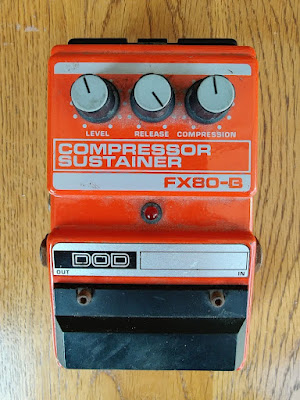
7. DOD FX80-B Compressor Sustainer


Provenance:  Flea market. Same day and same guy as the Arion tuner.

Cost: $8.  There is a price sticker on the pedal saying "$58".

Category: Used, vintage.

Review: This one is even more of a mystery than the Behringer Compressor-Sustainer.  Definitely changes the tone, definitely in a different way than the Behringer, and controls definitely are doing something that Behringer controls are not doing and vice versa.  On the plus side, this pedal looks legit badass on the board, and perhaps this alone makes it worth keeping it on the board. Except, on the minus side, this is the only pedal I have with a non-standard power jack, so it has to work off of batteries. It also has a somewhat broken on-off switch (it turns on. and off. but not always and not when you want it to), so the battery runs out fast. 

Difficulty of use: Difficult, because I cannot connect what I think should be happening with what I am hearing.

Rating: B-. ("B" is for "Badass")

Verdict: Off-the-board. At least until I can figure out the power supply issue. My next goal is to make a small pedalboard of vintage used and abused pedals only, and this pedal will be the anchor there.


8. EX (ENO) AutoWah


Provenance:  Amazon. First ENO pedal I bought.

Cost: around $30.  

Category: brand new, bargain basement budget

Review:  This pedal possesses a wide range of tones and sounds. Unfortunately, most of them are not pleasant.  Here is my  two-star (**) Amazon review.

Meh. Extremely hard to find a sweet spot.  

I stand by it. There are only two controls, Level and Peak, but they are very difficult to place in a position that create a reasonable effect. Put them too low, and there is nothing. Move a bit higher and suddenly your guitar sounds like dogs are barking into your ear in a very foreign language. I was able to find some meaningful sounds after a while, but an envelope filter needs to do better. My Boss GP-10 has an autowah effect that I can tweak in all sorts of directions, and it remains playable. This pedal is barely usable.

The EX/ENO is a somewhat interesting beast in the realm of  bargain basement pedals. Where everyone else essentially repackages the same 8-12 pedals under different branding, and sometimes in different cases, these guys have pedals that no one else has made, which is why I bet on them twice for effects that other bargain basement brands just don't carry.  Both times I missed. Of the two, the Octaver is a bit more useful, but only because I personally have a use case for it. I don't have a solid use case for this auto-wah.

Difficulty of use: Difficult. Very hard to find the right tone. Definitely a disconnect between the target audience (people who are willing to pay no more than $30 for an envelope filter are probably mostly beginners) and the amount of effort and understanding of how envelope filters are supposed to work is significant.

Rating: F. I could have been charitable and given it a D-, but let's be honest here.

Verdict: Off the board. Probably forever. The design is kind of cute, so it has a spot in my Cabinet of Curiosities.


9. Behinger UW300 Ultra Wah


Provenance:   Flea market. Elder kid found and scooped it for me.

Cost: $5. I wish flea market had more people selling pedals.

Category: used, bargain basement budget.

Review: Unlike the previous envelope filter, this one is very workable.  I watched some Youtube videos, and followed the pointers on the settings. There are definitely positions there that will make you want to curl in a corner and cry, but this pedal is quite versatile, and it is possible to dial back from those harbingers of hell into a much more friendly territory. At the end, I found the settings that produce a decent "wah" no matter how hard I hit the strings, while still reacting to the dynamics in a proper way.  

This pedal originally sat after the drives and before the modulations and time-based effects in my chain. After I got some delays, I temporarily displaced it and put it second in the chain after the CryBaby. I also may have hooked it to 18V power rather than 9V.  This resulted in a very different tone. Most of the "wah-wah" were gone, but this pedal turned into a mid-booster and started distorting the sound. Interesting, if unexpected effect.

Difficulty of use: Moderate-to-difficult. If you are a beginner, watch a few videos about this pedal specifically, they will tell you what to expect. Familiarity with the physics of envelope filters is also a big plus.  But the pedal itself is relatively forgiving, except in a few places, so simple tweaking with the knobs via experimentation will eventually result in success.

Rating: B.  I don't need auto-wah all that often, but when I do, this pedal is more than enough.

Verdict: Keeper, and will return to its position between the drive pedals and the phaser.


Well, it's the end of the day. The expected pedal has not arrived, so the board is still standing empty. Next on our agenda are the multiple drive pedals.