Saturday, February 5, 2022

One year of playing with cheap pedals: a beginner's review. Part I.


During the COVID isolation times of Summer of 2020 I went back and restarted playing guitar.  My playing is still pretty bad, but I am enjoying myself.   My main rig is an el cheapo guitar with a Roland GK3 split pickup mounted on it going into a Boss GP10 and into a set of speakers/my PC in the home office.  Around November of 2020 I decided that I needed an analog setup in the garage (in part because my main setup did not work well with a looper - I could only loop through a DAW).  I assembled the pedalboard out of pieces of wood and metal bought at Home Depot and started buying budget pedals - thankfully there is a decent market for $20-40 beginner guitar pedals. 

Today, in anticipation of a new pedal (large in size) arriving to my house, I decided to revisit the pedalboard, fix a few things and rebuild the signal chain.  While doing so I decided that I want to record my experiences with each of the pedals. Not certain who this might interest, but I am very much a beginner, and I expect that the target audience for most of these pedals are other beginners like me who are trying to figure out how to work pedals in their signal chains and don't want to spend significant amounts of money, because a $400 pedal makes significantly less sense when you are playing a $100 guitar into a $150 amp.

We'll do it in parts.... Part 1 is Utility Pedals.   By this I mean everything in the chain before the overdrives, although, of course several of these pedals can be placed in various locations, and I have had them in various locations.


Part 1: Utility Pedals.


1. Arion Stage Tuner


Provenance.  Bought used at a flea market for $5. 

Cost. $5.  Cannot beat that.

Category: Vintage, used.

Review.  This is my only pedalboard tuner. I was thinking about getting one, but did not want to waste space - I usually just use a clip-on tuner for the garage guitar that is played through the pedalboard. But I go to the local flea market with one of the explicit goals being to look out for music gear, and so when a random guy had two pedals, I bought them both (the second one is the DOD Compressor discussed below). The surprising thing - given how beaten up it looks (and feels too - it's pretty much plastic), is that it works and actually tunes the guitar.  It does take up more space on the pedalboard than a tuner should occupy, but I kind dig the fact that it is so old and beaten up.  

One thing to note - this pedal does not kill the signal. I like it, because I don't have a use case where I need to tune the guitar and not hear it being tuned (this is not a concert rig, and will never be a concert rig).

Difficulty of use: Easy. Turn it on and just start tuning.

Rating: 
 C.  (does its job)

Verdict: Probably a keeper on the board, just because it has character. 


2. Dunlop CryBaby GCB95


Provenance. The only true pedal I won in a shopgoodwill.com  auction. 

Cost. About $45 with delivery.

Category: Vintage, used.

Review. This pedal stood unplugged on the board for the longest time because I did not have a space on the power supply initially to hook it up, and it burned through batteries like crazy. But after I got my second power supply, I hooked it up, and now it is the first pedal in the chain.  I don't play it too much, but it is the real deal. The wah is awesome and works well with pretty much any level of overdrive and any other effects I have on at the moment.  Because my pedalboard has pedals about two-tow and a half inches  up above the floor, the physical act of constantly stepping on and off the pedal is a bit awkward (and thus I don't play with it as much as I should). It also does not always hold the position perfectly when left alone, so tricks with cocking it half way are a bit harder.

Difficulty of use: Easy.  Awkward placement of foot aside (this is my local pedalboard issue, not a global problem with the pedal itself), it's easy to operate and get great sound out for even an absolute beginner. Hit it, pull the pedal back, and start rocking it. The range of tonal changes is very impressive.


Rating: 
 B.  (great sound, rarely used)

Verdict: A keeper. I might consider putting it on the floor next to the board.


3. MiMiDi The Noise Noise Gate


Provenance: Amazon. One of the first set of budget pedals I got in late 2020.

Cost:  About $20 give or take a couple. It was on a small sale, I think.

Category: New, bargain basement budget.

Review.  Hum and noise from the amp was the reason why I stopped playing guitar 10 years ago. So, as I was returning to playing guitar, the hum in the amp persisted and I tried figuring out what to do about it for a long time. This noise gate - if not the final solution - at the very least keeps the beast at bay. My current rig definitely hums when more than one overdrive pedal is engaged and it is definitely unpleasant. This pedal helps take the edge off.  It is a little bit too aggressive at times - if I put it past 12 o'clock (like it is on the photo above), it starts killing a lot of sounds it should not be killing.  I have not found much use for the hard-soft switch - I usually keep on in the "soft" position.

Difficulty of use: Easy, for the most part. Sometimes finding the right position to cancel most of the noise without ill effects on the sound is a bit cumbersome, but with only one knob, tweaking it is straightforward.

Rating: B- (good for the price)

Verdict: Keeper. Unless someone points me in the direction of a cheap holy grail noise gate, I see no reason to replace this one, and I definitely need a noise gate on the board.


4. VSN GT EQ


Provenance: Amazon.  Also grabbed in Black Friday sale in 2020.

Cost:  About $23-25.

Category: New, bargain basement budget.

Review.  The unsung hero of the pedalboard perhaps, and one of the workhorses. It definitely affects tone in profound ways. I keep it at the beginning of the chain, but I keep on thinking of putting it at the very end to use, in part, as an attenuator.  Nevertheless, it definitely makes a difference when it is on. Figuring out what EQ you need for a specific signal chain is definitely a more challenging task then (for example) turning the knob of a noise gate, and this EQ pedal is quite sensitive, while the sliders are rather cheap, so a bit care is needed to set it up.

I've had success with the following uses:

  • Booster. Ramp the volume up, and move the highs and the mids above the median.  Moving the EQ all the way to the top starts breaking the amp much sooner. So, even with no overdrive pedals and going into a clean amp, I can manage some level of dirt with it.
  • Tone warmer/Bass. Dampen the highs and the mids, boost the lows. Small boost warms the tone, larger boost dulls it considerably. Used with the Octaver pedal (see below), the latter combination turns my guitar into a poor man's bass.
  • Treble boost. Up the treble, lower the lows. This is my default setting on the EQ, it helps with pedals that produce muddy lows, this is pretty much every overdrive I have.
  • Mid boost.  Used it with the scooped-middle Tantrum (See Part 2), and for a few other high gain sounds.  Usually I just add a little bit of mids to the treble in the treble boost setup.
Difficulty of use: Moderate. If you are a beginner, getting it to produce the exact tone you want and making it play nice with your overdrives requires quite a bit of trial-and-error.  The sliders are also a bit tricky to control to place exactly where you want them.

Rating: A. Very helpful with kicking, or taking the edge off a wide range of tones that the rest of my board can produce.

Verdict: Keeper. A better EQ may be warranted, but this does the job for very little money and occupies very little space, so I am not too compelled to replace it. And an EQ pedal on the board very valuable to me.

5. ENO EX OCT-1 Octaver


Provenance:  Amazon. Bought it recently, got interested in playing with an octaver, this is one of two cheap ones available.

Cost: around $30. I think I waited for a small sale.

Category: brand new, bargain basement budget

Review: This is a really weird one, but at the end of the day, not a very useful one. Definitely not as useful as four octave knobs would have you believe. In fact, only one combination is really usable for a beginner.  Here is what I wrote in my two-star (**) Amazon review:

There are four octaves on the pedal, the "normal" one, one down, two down and one up. They can be mixed in any proportion to create a variety of sounds. My first two days of playing the pedal were very confusing. After that I watched some youtube videos and was able to harness this pedal somewhat. Here is a brief narrative.

1. Two octaves down is rather useless. In isolation it produces a very dull sound that isn't particularly useful by itself, nor does it play well with the rest of the pedalboard (note: my chain here is Octaver -> Compressor -> overdrvies and fuzzes -> flanger -> phaser -> delay -> reverb -> amp).

2. One octave down is workable. After some tweaking and mixing octave down with normal signal I am able to get a sound that with addition of some careful warm overdrive can approximate bass, which allows me to lay down a simple bass loop when I am practicing.

3. One octave up is weird. The signal it produces in isolation (when all other octaves are set to minimum) is this really thin fuzz. It is NOT an "octave fuzz" per se (nor have I seen this pedal call itself "octave fuzz" anywhere), and the signal sounds very similar to what happens when I am playing out of phase pickups running through a regular fuzz with EQ controls boosting the treble. By itself this sound is somewhat unplayable, but... When you hit an actual fuzz pedal with it (or another saturated overdrive/distortion), the octaver enriches the sound and actually sounds good.

Overall verdict. This is a somewhat playable pedal, but there is a mismatch between its entry-level price - and thus - a very entry-level target audience (like myself), and the actual amount of effort needed to make this pedal produce useful and useable tones. Basically, if you are beginner guitar player on a budget and want to find out what an octaver pedal is, this pedal isn't really your friend. Your experience is likely to be confusing and frustrating, unless you are willing to watch about an hour's worth of youtube demos and explanations, and put additional pedals on your pedalboard that play nice with this one.

One beginner use I can see, that can be reached without much trouble is a poor man's bass. Minimize ocatave up and two octaves down, get octave down past 12 o'clock and adjust normal octave to your liking, and then adjust gain/tone on subsequent drive pedals and the amp, and it'll serve the purpose until you buy your first bass guitar. But this pedal is supposed to be more versatile, and it really requires a lot of effort to make workable, effort that a lot of other entry level pedals just do not require.


Difficulty of use: Difficult, as explained above. Most of the noises and knob combinations are unusable and discouraging. Use of higher octave requires a saturated distortion/overdrive/fuzz downstream, and even then, it is not a given that you'll like the result. Use of lower octave requires careful calibration.

Rating: D.

Verdict: Keeper for now, as I don't have anything better. Permanently set up in a "poor man's bass" position.  I might buy the Behringer octaver next before deciding if I want to spend four times the money on a real thing.


6. Behringer CS400 Compressor-Sustainer


Provenance:  Sweetwater, during one of their $19/pedal deal on Behringers

Cost: $19

Category: brand new, bargain basement budget

Review: I can definitely tell the difference between the tones it generates - both different setting combinations and on/off. But even after watching multiple Youtube videos, this compressor is not easy to get under control.  What's depicted on the photo is my main setup, with both Attack and Sustain at the max. I occasionally move the compression rate back and forth. Higher compression rate seems to result in more dirt/overdrive.  It is helpful somewhat when I am strumming clean, but I usually keep it off.

Difficulty of use:  Difficult. I feel like even after a year, and countless youtube videos, compressors are still a bit of mystery to me, because what I hear folks say on the youtube channels, and what I hear my compressor do, are two different things. This is probably me not hearing the right things, so bygones. What's important though is that if you are a beginner, this pedal may baffle you before it starts serving you well.

Rating: C. Presumably, it is doing its job.

Verdict: Keeper for now. 


7. DOD FX80-B Compressor Sustainer
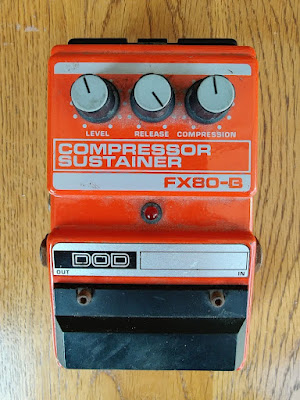


Provenance:  Flea market. Same day and same guy as the Arion tuner.

Cost: $8.  There is a price sticker on the pedal saying "$58".

Category: Used, vintage.

Review: This one is even more of a mystery than the Behringer Compressor-Sustainer.  Definitely changes the tone, definitely in a different way than the Behringer, and controls definitely are doing something that Behringer controls are not doing and vice versa.  On the plus side, this pedal looks legit badass on the board, and perhaps this alone makes it worth keeping it on the board. Except, on the minus side, this is the only pedal I have with a non-standard power jack, so it has to work off of batteries. It also has a somewhat broken on-off switch (it turns on. and off. but not always and not when you want it to), so the battery runs out fast. 

Difficulty of use: Difficult, because I cannot connect what I think should be happening with what I am hearing.

Rating: B-. ("B" is for "Badass")

Verdict: Off-the-board. At least until I can figure out the power supply issue. My next goal is to make a small pedalboard of vintage used and abused pedals only, and this pedal will be the anchor there.


8. EX (ENO) AutoWah


Provenance:  Amazon. First ENO pedal I bought.

Cost: around $30.  

Category: brand new, bargain basement budget

Review:  This pedal possesses a wide range of tones and sounds. Unfortunately, most of them are not pleasant.  Here is my  two-star (**) Amazon review.

Meh. Extremely hard to find a sweet spot.  

I stand by it. There are only two controls, Level and Peak, but they are very difficult to place in a position that create a reasonable effect. Put them too low, and there is nothing. Move a bit higher and suddenly your guitar sounds like dogs are barking into your ear in a very foreign language. I was able to find some meaningful sounds after a while, but an envelope filter needs to do better. My Boss GP-10 has an autowah effect that I can tweak in all sorts of directions, and it remains playable. This pedal is barely usable.

The EX/ENO is a somewhat interesting beast in the realm of  bargain basement pedals. Where everyone else essentially repackages the same 8-12 pedals under different branding, and sometimes in different cases, these guys have pedals that no one else has made, which is why I bet on them twice for effects that other bargain basement brands just don't carry.  Both times I missed. Of the two, the Octaver is a bit more useful, but only because I personally have a use case for it. I don't have a solid use case for this auto-wah.

Difficulty of use: Difficult. Very hard to find the right tone. Definitely a disconnect between the target audience (people who are willing to pay no more than $30 for an envelope filter are probably mostly beginners) and the amount of effort and understanding of how envelope filters are supposed to work is significant.

Rating: F. I could have been charitable and given it a D-, but let's be honest here.

Verdict: Off the board. Probably forever. The design is kind of cute, so it has a spot in my Cabinet of Curiosities.


9. Behinger UW300 Ultra Wah


Provenance:   Flea market. Elder kid found and scooped it for me.

Cost: $5. I wish flea market had more people selling pedals.

Category: used, bargain basement budget.

Review: Unlike the previous envelope filter, this one is very workable.  I watched some Youtube videos, and followed the pointers on the settings. There are definitely positions there that will make you want to curl in a corner and cry, but this pedal is quite versatile, and it is possible to dial back from those harbingers of hell into a much more friendly territory. At the end, I found the settings that produce a decent "wah" no matter how hard I hit the strings, while still reacting to the dynamics in a proper way.  

This pedal originally sat after the drives and before the modulations and time-based effects in my chain. After I got some delays, I temporarily displaced it and put it second in the chain after the CryBaby. I also may have hooked it to 18V power rather than 9V.  This resulted in a very different tone. Most of the "wah-wah" were gone, but this pedal turned into a mid-booster and started distorting the sound. Interesting, if unexpected effect.

Difficulty of use: Moderate-to-difficult. If you are a beginner, watch a few videos about this pedal specifically, they will tell you what to expect. Familiarity with the physics of envelope filters is also a big plus.  But the pedal itself is relatively forgiving, except in a few places, so simple tweaking with the knobs via experimentation will eventually result in success.

Rating: B.  I don't need auto-wah all that often, but when I do, this pedal is more than enough.

Verdict: Keeper, and will return to its position between the drive pedals and the phaser.


Well, it's the end of the day. The expected pedal has not arrived, so the board is still standing empty. Next on our agenda are the multiple drive pedals.


Saturday, January 25, 2020

Dover Canyon Library Wines


Happy New, Old and New Lunar Years!

I still need to finish the report on the Jeju Island trip (Day 4 was the longest, will take a lot of photos and text to describe, other days are more straightforward).

In the meantime, let's start a new series.  We are members of Dover Canyon Winery wine club, primarily for the ability to buy Cujo Zinfandel at a pretty darn good discount, although we've discovered since joining the club that pretty much every wine of theirs (and their wines these days are all Zinfandels and Zin blends) ranges from pretty darn good (Primitivo, Renegade Red) to amazing (Dusi).

Yesterday I got an email from Dover Canyon informing me (and other club members, I am assuming) that they are clearing their storage and have a bunch of wines from 2000-2010 they are trying to get rid of. Buy one regular bottle, get a library bottle free.  

So, today, we trekked to the winery, and got a case of Cujo, Renegade Red and Vincenzo, and added to it, a total of 14 vintage bottles in the picture above.

The plan is to blog opening of each of the bottles as we decide to go through this stash, and document which wines turned out great and which - less so.  Some of these bottles are quite literally the last bottle available of the wine....


From left to right:

2007 Zinfandel Port (2 bottles).  I have a Zin Port from something like 2010, I think, and one more - 2017 vintage. They Port has been great, and these bottles can be kept for a while.

Non-vintage  Renegade (1 bottle). A blend of Primitivo and Zin today, I wonder what it was back when this bottle was released - judging by the label - some time in 2007-2010. 

2007 Reserve Syrah (1 bottle). A candidate for being opened first, and if not the only bottle left, then one of just a few. The label says 65% Jimmy's Vineyard, 35% Stark Ranch, bottled in March 2009.  2007 was a great year for Syrah (one of my favorite wines ever was Ancient Peak Syrah from that year).

2004 Jimmy's Vineyard Syrah (1 bottle). Different label style and the oldest Syrah we got. They produced (according to the label) four barrels of this wine ~ 100 cases, I am guessing. I am pretty sure they had only one bottle of this wine left, so when we open it, this will be it for this vintage.

Last bottle to 2000 Menage with the pre-St. Bernard label.


2000 Menage (1 bottle). This one we were told was the last bottle ever. 64% Cab Sauvignon,  22% Cab Franc, 14% - a pure Bordeaux blend, different from the 2009-2010 blends that are (see below) mostly Rhone varietals.  The label predates the introduction of the iconic St. Bernard (see archive photo below).  I am really curious about this one. It's pretty much the two Cabs, so it has a chance to turn out really well.  This is possibly (see below) the oldest bottle of wine we brought home.


At Dover Canyon winery in 2013, with the St. Bernard.

1997 Dusi Zinfandel or 2009 Dusi Zinfandel  (1 bottle) in an umarked bottle (the writing was done in front of us). The other candidate for the oldest bottle, if it winds up indeed being 1997. It is more likely that it's a 2009 Zin, which, given how great Dusi Zinfandel is, might wind up being the best wine form the bunch.


2007-2010 wines
2008 Jimmy's Syrah (2 bottles).  The most recent of the three Syrahs we have. We have two bottles, so one of them might also be opened pretty soon.


2008 Grenache (2 bottles). Another two bottle pickup, so one bottle can also be opened shortly. According to the label, 75 cases produced, and bottled in March of 2010.

2007 Carmenere (1 bottle). 50 cases produced, Bottled in March of 2009. I believe they had only a small handful of these bottles left. as well. We were asked specifically to let them know how it turned out  - which gave me the idea to blog the whole experience of drinking these wines.

2009 Menage (1 bottle). This and the 2010 Menage were actually for sale, and were open at the winery so we tasted it. This vintage is 38% Carmenere, 25% Cabernet Sauvignon, 25% Syrah, and 12% Grenache.  Tasting notes from the tasting are below.

2010 Menage (1 bottle). This wine eliminated Cab Sauvignon from the blend, leaving it a Rhone Carmenere (52%) - Syrah (26%) - Grenache (22%) blend. We got to taste it too before deciding to get a bottle of each to  complete the raid on Dover Canyon's library.


Tastings. 

While at the winery, we tasted the 2010 and 2009  Menage and a 2004 Viognier - the only white wine that participated in the mix.

Menages.  We tasted the 2010 vintage first, as it is much lighter (absence of any Bordeaux grapes). Interesting wine - no tannins and no residual sugar to speak of - very light. Starts quite bland, but the finish is interesting and flavorful. Our conversation was about the need to decant this wine before drinking and let it breath for 5-15 minutes.  

Then came the time for the 2009 blend. We also did a side-by-side for these two. The Cab definitely makes this vintage more expressive, although it still is pretty low on tannins, I think. The two wines create a nice contrast, and I think we should open them and do side-by-side tasting at a single occasion.

2004 Viognier.  We were offered this bottle - also the last of the batch and agreed to take it. This was the last bottle of that particular wine. In the followup conversation we asked for the bottle to be opened and together all three of us have sampled it. After that, the bottle, by chance was placed under the table - where all other bottles were, and I did not notice that, so instead we wound up picking up that 2007 Carmenere,  This wine definitely is past its time. We nose is rather stale - ripe banana is one note that was distinct. The taste though was pretty good for a 16-year old white wine. There is some residual sugar in the bottle, and with age it became more prominent, but it does not dominate the wine. I was the only one of the three of us who tried it to appreciate it fully.  


So, that's the story. I'll post more entries in the Vintage Wine Tasting series, as we open and drink the bottles. In the meantime, I have "documented" these bottles individually for posterity. We'll probably keep a couple of empty bottles when we finish them (I am thinking of keeping the 2000 Menage for the label, and the Dusi bottle because, heck - autographed!)

In the meantime, I decided to use the bottles as a backdrop for shooting some thematically appropriate playing cards... With only 7% of battery, I did not make it a long photoshoot, but I did get to place a few of the decks in the environment. As a parting shot, below are the pictures of King's Wild Project's Maduro deck, and with Stockholm 17's gaff cards from the Parlour project.

Dover Canyon Library wines with King's Wild Project's Maduro playing cards


Dover Canyon Library Wines with Stockholm 17's (and Gentleman Wake's) Parlour gaff cards.

Saturday, October 12, 2019

Trip To Jeju Day 3: RE CARES Lives!

RE Cares 2019: Day 1.

Monday greets us with beautiful skies, light breeze, warm temperature and a sight of airplanes in the air. Still jetlagged, I wake up around 5am, spend the rest of the morning prepping for the conference.
Texts and emails from other folks who landed on Jeju last night confirm their presence, and it looks like we will make it today...

I take the Promenade to Ramada Inn where the conference is scheduled to take place. No police officers try to stop me, and there is no reason - no high waves, the ocean is fairly quiet, and, again, the sun is starting to shine.

Monday morning: clearing skies, and airplanes in the air (view from our hotel room).
Olga is planning on heading somewhere on the island - I won't know her exact plans until later, as once I get to the conference, I am pretty much consumed by the event.

At the Ramada, I register and get my badge, meet Seok Won Lee, the conference organizer who has been working tirelessly for the last two days to salvage the workshops. I also meet one by one old friends and comrades-at-arms when it comes to organizing RE Cares.  After a short trip for coffee, we get to our room and meet our stakeholders who showed up in force - about 10 people are filling in the room. 

For all the excitement of the last 48 hours, the event runs pretty smoothly. 

I am opening RE Cares 2019: the only Monday event left on the program.

I open with a few quick remarks and pictures of typhoon-ridden Promenade. We introduce our presenters for the morning: David Callele to talk about requirements, our stakeholders to present their problem, Gunter Mussbacher to summarize our work to date.  

Our stakeholders want a mobile app that would help visitors, especially those who are mobility impaired, plan a trip to any of Jeju's tourist attractions using public transportation - where appropriate - accessible for people in wheelchairs.

The Q&A with the stakeholders runs over time, but we still get a quick break, and after that start work on the requirements, trying to put as many notes on the wall as we can.

.
RE Cares 2019: Sorting the requirements into piles 
RE Cares 2019: our data/database requirements collected in one place.


 After that we take the picture at the top of this entry, and proceed to an improvised lunch Seok Won set for us - hot dogs and pizza - the least Korean food I've eaten in Korea, but with some distinct local flavor added.  After lunch we proceed through the synthesis exercise - form groups by interest and start going over the requirements and summarizing them. I am running the database group, and in a matter of about an hour and a half, we put together what looks like a comprehensive list of all the data we need.

RE Cares 2019: ... and the database is born (-:

At around 4pm we break, and start presenting our results: there are five teams in total, each dealing with specific aspects of the system: data, accessibility, UI, social and gamification features, and so on. At the end, four of us remain to merge the artifacts into a single document, which I will spend two days editing like crazy to turn into a semi-final requirements spec.


Meanwhile, Olga has successfully left the city, and traveled west to find a tea plantation. She is having issues with the navigation: the Naver app often does not load the street maps; it also makes it difficult to pick certain destinations.  Olga fails at her attempt to find one such destination, that is close to the plantation, and winds up, as her second tourist attraction, at something called The Glass Castle.

Tea grows at, well, tea plantation.


At the Glass Castle.

A guitar made out of glass.

Around 6pm she makes it back to our hotel and walks to Ramada to meet us - a crowd of about 25-30 people planning dinner. Our Korean stakeholders are figuring out which restaurant can accommodate so many people and eventually settle on a black pork bbq place that is located not too far from our hotel. We walk to it - first along the Promenade, then - along the street connecting the hotels. When we arrive, the restaurant is empty - looks like it is too early for dinner.

About Coffee, which we visited on Sunday, and the BBQ restaurant we visited on Monday.
We get settled at tables - ours has four people and in addition to Jane Hayes, my old colleague and collaborator, we have one of the locals, Suenboom, a CS student from Jeju National University. We get our table set for us - with a wide selection of salads and kimchi - probable the largest total number of different kinds we had anywhere.

Table set for four people. The grill is in the center.

We each get a slide of pork thrown on the grill on our behalf: for our table it's two neck and two belly slices. While they sizzle, we drink and chat. The waitress comes to the grill with big scissors which she uses to cut the large pieces of meat not bite size ones that we can actually eat with chopsticks. We try, for the first time, seasame leaves as the pork wrapper and find that they work much better (especially, in my case, when paired with hot peppers) than lettuce. The food is good, but the pork is quite full of fat, and so, this is a heavy meal for us.


Kimchi, salads and wrappers for pork.

When we are done, a long complicated procedure for paying for 27 or so people ensues. We don't need receipts, so we get out cash, and give it to Suenboom. We then leave the restaurant, stop over by the Antoinette coffee shop across the street, where Olga gets a drink, wave at our colleagues who are on the prowl for ice cream, and head towards our hotel. When we approach the hotel, the fish restaurants are at their brightest, with people standing in front of each door with menus and trying to convince us to walk in. It is easy to say no - we just had dinner, but we still look at the menus to try to figure out the prices for abalone, and some of the other seafood.

Seafood restaurants next to Whistle Lark Hotel. We are being invited to come in.
The prices turn out to be quite steep - abalone is $85-90, some fish at $50-70 (I can see how these can be prices that work a full meal for two people, but just for comparison, our BBQ pork dinner was 17,000 won - around $15. 


The seafood row in the evening.

We walk along the seafood row taking pictures and looking at the menus, then head to our room. I try to work on our requirements document, hopelessly fall asleep after about 40 minutes of work. So, that completes our first day at the conference.

Tuesday is the big one - our one full day of tourism together.


Saturday, October 5, 2019

Trip to Jeju Day 2: Typhoon and Scramble

Typhoon hits Jeju.

We wake up in the middle of the night in a dark hotel room with a heavy rain outside, and finally plug in our phones and other devices. I spend time on the laptop. Reports from other RE Cares folks are coming in - they are stranded in Beijing, Osaka, Seoul.... Still hoping to make it to Jeju before Monday morning.

By about 7am, it gets lighter, but the rain is still on-going. We realize that the balcony door is leaking and call the front desk. Five minutes later, a hotel employee knocks on the door. He first tries to simply plug the leak, but then realizes that the water is coming from the top of the window, not the bottom, and calls in to have us moved. We pack bags, and a nice lady from the front desk escorts us to the sixth floor.

Our new room is ocean facing - offering us a better view of the carnage the wind and rain are doing to the promenade underneath the hotel. It is also a "family" room with two beds (a full and a single), but it is lacking an armchair from our previous room. Somewhere in the move I seem to have misplaced my Cowon MP3 player (I joke later, when we leave the hotel, that the player has returned to its motherland to die).  


By 8:30am, we have moved, are dressed, hungry, and want to get outside. There is a 7-11 store right next to the hotel and we had there first, braving the rain.

Outside Whistle Lark Hotel: 7-11.

We get coffee and some snacks - pastries, and a seeweed-rice-meat triangle that Olga once saw discussed in an "influencer" YouTube video, and eat right there, under the rain.

We then inspect the small street extending past the hotel, and full of the (now closed) seafood restaurants, with fish tanks full of fish, shellfish, albacore, and octopi.  Olga looks and them and tells them to enjoy the extra day of life they get due to the weather. 

The ocptopi in a fish tank: the stores are closed, they get another day to live.

The fish market in the morning.
We leave the strand an walk into town trying to find something open. It takes us about 30 minutes of navigating the narrow streets of the block just south of the hotel to find something. The block itself is pretty much a mall, with a variety of clothing and shoe stores, last fashion and everything, except for the fact that all of them are closed.  One street is covered, and we - already rather wet - walk it in its entirety, just because we get less rained on this way. Eventually, we hit the jackpot with a coffee shop called About Coffee which serves coffee and pastries (with a weird buy two drinks, get a free cake scheme going on). We buy two drinks and get a free tiramisu cake, which winds up being quite good - just like pretty much any other pastry we try in Korea. We also pull out the remaining pastries we bought at 7-11, and finish them as well.

Eating the tiramisu, at About Coffee.
While finishing our drinks and trying to dry out just a bit (I am wearing a rain jacket on top of the hoodie, but the hoodie is all wet) we also peruse the coffee shop's wi-fi to figure out what is open around. Turns out, 300 meters away is an underground market named Jungang Underground Shopping Center. "Underground" means no rain, so we head there. It is just past 10am, and as we descend underground, the shops are only starting to open. The market runs straight under Gwandeng-ro -- a local thoroughfare, and spans two large blocks.


Jungang Underground Shopping Center on a lazy Sunday morning.
There are two types of stores there: cosmetics, and clothing.  We walk to the end of the underground passage, and there I read the the stairs up lead to Dongmun Traditional Market. We get out, and head there, pausing for a few minutes to shop for a few things at a Daiso store we spot on the corner.

This is the first of our many visits to Dongmun market. Looking at the map of Jeju city, it becomes clear that the market itself is a  long (300 meters, or so) covered street running through the heart of a large block, with a lot of side passages leading outside.  On one side of the market is fish.

Hairtail fish at the Dongmun Fish market
Lots of fish. We see the same aquariums with live fish, leading to small restaurants with second-floor seating.  We see fishmongers cutting the fish and setting it up for immediate sale.

Dongmun Fish Market - a typical fish stall.
We see sashimi being made and sold right on the spot....

In a separate passage, we find the citrus avenue. Lots of stalls selling satsuma tangerines, and a local orange hybrid. Olga goes for satsumas, eventually buying about a kilo for 7,000 won. I like the oranges - we spend another 3,000 won on three of them. At some point our strolling back and forth the isle leads to the ladies who hold the tangerines for tasting to start withholding them from Olga (although I am faster than them, and I get a few more tastes).
Dongmun Market: the main passage.
Finally, from the side passages, we get to the main one, containing a mix of food stalls, black pork vendors, souvenir shops, and a few more things - terminating at the very end of the market with one big cloth bazaar.

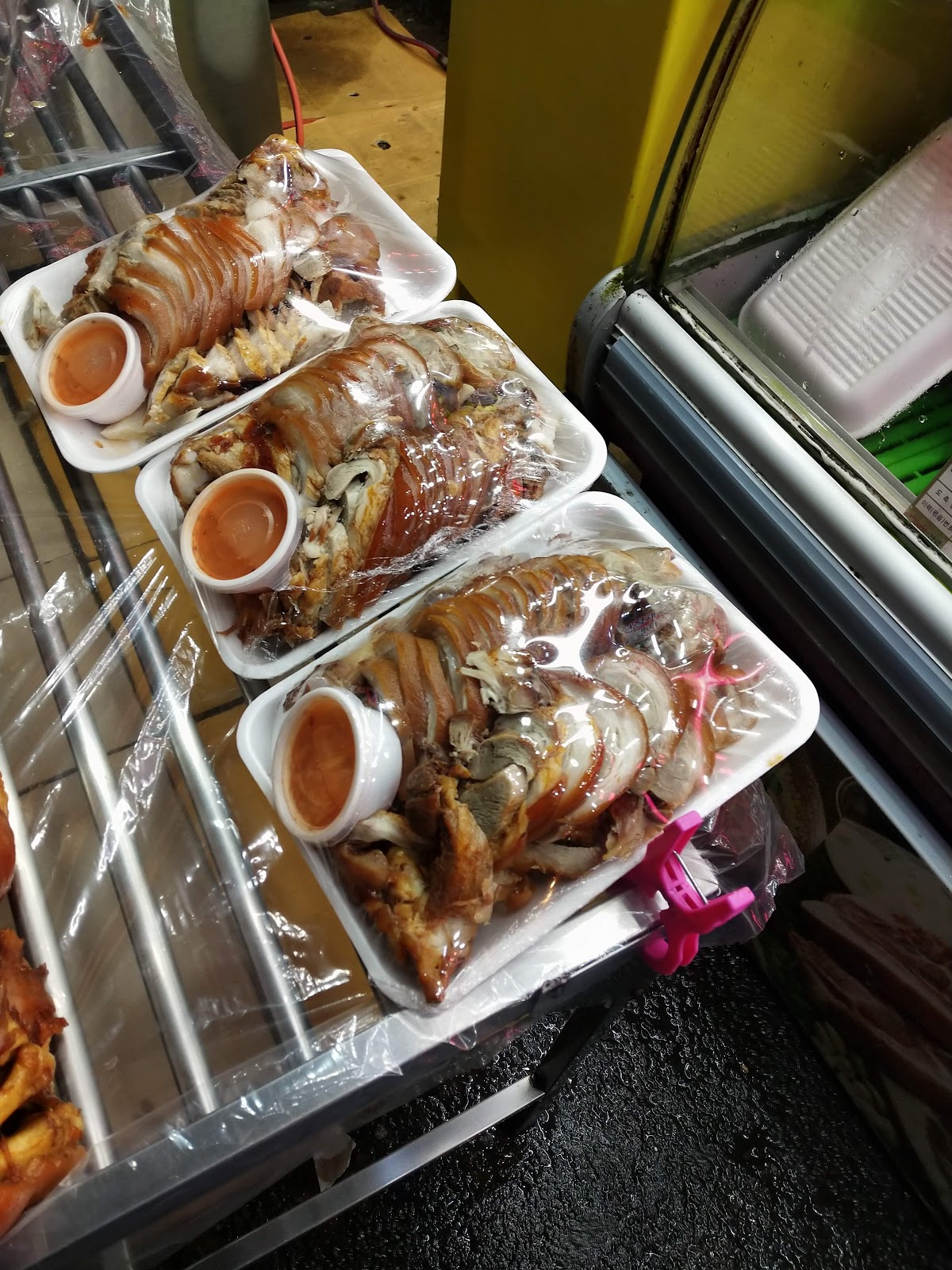
Black Pork vendors have pig heads.


Following Aldrin's advice, I buy hallabong juice. There are no hallabongs for sale (we only see satsumas, and the other hybrid oranges, but no citrus has hallabong's trademark tangelo-style protrusion at the top).  The juice is good. Achievement unlocked!

Hallabong juice at the Dongmun Market.

Our cash is running out just as the market is coming to life (it's around noon by now). On Saturday, I used an ATM machine at the airport to get some money, but got confused with the number of zeroes, and got around $30, instead of the intended $300. $1 is around 1100 Korean won; all prices are pretty much in thousands of won, so it is easy to think of, say,  5,000 won as $5 (although it is more like $4.5). And we are down to less than 20,000 won.  The first three ATM machines - inside the market, and just outside it in a couple of banks spit out my card without comments or money.  Finally, we find Jeju bank, and its ATM machine cooperates. We get out 300,000 won - turns out, it is enough cash for the rest of the trip.  Glad to have the cash, we dive back into the market. and walk through a long seafood passage full of fishmongers cutting sashimi. We decide that sashimi is a good thing to eat, and start looking for some fish that is not your typical salmon or tuna. In one stall we notice some interesting-looking sashimi. Olga asks the woman behind the stall (via gestures and English) what fish they are. The woman picks up a net, and pulls out one after another three fish from her various fish tanks. We are pretty certain we've never seen any of these fish before. We make another circle of the fish isle, but eventually we approach the same woman and ask her (again, via gestures) to make us a half-and-half sashimi of two different kinds of fish (most of the sashimi platters we see are a single kind of fish and we want to try different things).  The woman goes behind the curtain, then brings two fresh filets and immediately slices them and arranges them on a bed of diakon.  10,000 won and we have a large tray of sashmi!

The next step is black pork. Apparently, pigs on Jeju are all black in color, so "black pork" is not "pork meat that is not white meat", but rather "meat of the black pig".
Black Pork at the Dongmun market.
We find a vendor that sells small-ish trays of black pork (big ones go for 10K won, ours is 7K won), and get one such tray.  Then we hit the actual street food vendors. First, is a stall where we buy a crab shell stuffed with crab, cheese, baby shrimp and a few other things, and roasted  with a flame thrower.

Food vendor at the Dongmun Market is working on Olga's stuffed crab.

The second thing we get there is a stick with a bunch of fried things: from crab to chicken, to cheese, to kimchi, to cellophane noodles.


Stuffed Crab
Comparative analysis of stuff on a stick and the legend

We then find another place that sells rice cakes, blood sausage, tempura, and fish cakes. Olga has a few pieces of tempura, while I get a somewhat healthier order of fish cakes - thin strips of fish on a stick (mine were unfortunately removed from the actual stick making them harder to pick up and eat) boiled in water.

At around this time, all hell breaks loose at the conference. The weather we are having has officially been called a typhoon, and the typhoon has successfully grounded all flights to Jeju from three countries (mainland Korea, China and Japan).  The conference organizers are working hard on moving all Monday workshops to Tuesday, because most workshops are lacking presenters. RE Cares, our event, is in a bit of a pickle too. I am in Jeju City, and so are two other co-organizers. But five more are stuck in three different countries, and some already know they are not coming until Monday night or Tuesday morning.  Unlike all other workshops though, our Monday goal is to meet with local stakeholders - it is a large group of college and high school students, who already made their plans for Monday.  So, we decide to buck the trend and run RE Cares on Monday. 

On the way home I text and email frantically at everyone who is here, and everyone who is not. We make some quick decisions. The three of us already here plan to skype at 8pm.  We are also monitoring a few long threads about changes in the schedule (as everyone except for me is also leading some other event at the conference).  In the meantime, it's about 3pm, Olga and I are heading home, and the rain and wind pick up and really get into it.  We arrive to our hotel room soaking wet, shed our clothes, take hot showers, and attack sashimi and pork that we brought home with us.

Eating sashimi at the hotel.
We like sashimi. The black pork is nice, but too fatty, and we have way too much of it.

I get on the laptop and start figuring out what to do on Monday. A plan starts forming. For simplicity, we will run the event precisely as planned, but we do have to replace a few pieces. Around 5:30pm the rain lets up, the wind drops, and there appear some clear skies out west. We get some good news - those of the colleagues and RE Cares co-organizers still planning on taking planes on Sunday board their planes and take off. 

Around the same time, we decide to take a stroll along the promenade and see how long it takes to get from our end to the other end where Ramada, the conference hotel is.

As we get on the promenade, I start taking pictures.

Jeju City - aftermath of the typhoon. 

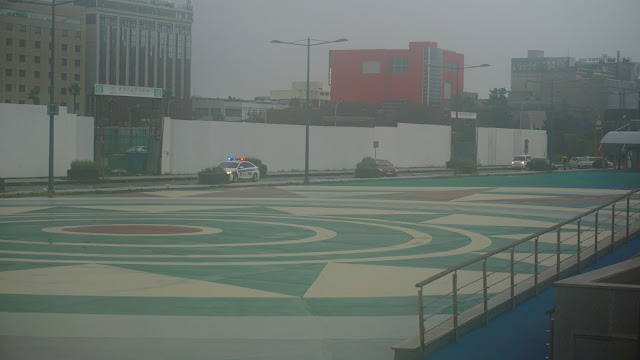
A police car parked nearby turns on the lights, drives in our direction and stops at the end of the street. Two officers jump out and run towards me. I figure immediately that standing on the promenade (the waves are still occasionally going over) is considered verbotten, and leave the promenade, hoping that I only get a verbal lashing (and thinking to myself that back in Russia this may already be reason enough to be detained, beaten, and convicted for resisting the authorities). The nice police officers gather between them enough English to convey to me exactly that: promenade is not safe, we should get to the street.


A police vehicle is approaching me.


We leave the promenade, and walk along the street leading from our hotel to Ramada. On the way we discover Antoinette - a somewhat pretentious and expensive coffee/dessert shop (more on it in later posts), Martro - the Costco of South Korea (yeah - actual Costco - they sell Kirkland products there), and E-Mart, a department store, complete with a grocery store underneath it. We buy some food and supplies at Martro and E-mart, head back to the hotel, reach it by around 7:40pm, just in time for me to set up and get ready for the 8pm "So, what are we going to do about tomorrow?" telecon.

At the telecon, we discuss the plans, go over the Monday program, and pep talk each other. By this time some triumphant messages from our colleagues who have landed on Jeju reach us, so the main stress is over.