Saturday, October 5, 2019

Trip to Jeju Day 2: Typhoon and Scramble

Typhoon hits Jeju.

We wake up in the middle of the night in a dark hotel room with a heavy rain outside, and finally plug in our phones and other devices. I spend time on the laptop. Reports from other RE Cares folks are coming in - they are stranded in Beijing, Osaka, Seoul.... Still hoping to make it to Jeju before Monday morning.

By about 7am, it gets lighter, but the rain is still on-going. We realize that the balcony door is leaking and call the front desk. Five minutes later, a hotel employee knocks on the door. He first tries to simply plug the leak, but then realizes that the water is coming from the top of the window, not the bottom, and calls in to have us moved. We pack bags, and a nice lady from the front desk escorts us to the sixth floor.

Our new room is ocean facing - offering us a better view of the carnage the wind and rain are doing to the promenade underneath the hotel. It is also a "family" room with two beds (a full and a single), but it is lacking an armchair from our previous room. Somewhere in the move I seem to have misplaced my Cowon MP3 player (I joke later, when we leave the hotel, that the player has returned to its motherland to die).  


By 8:30am, we have moved, are dressed, hungry, and want to get outside. There is a 7-11 store right next to the hotel and we had there first, braving the rain.

Outside Whistle Lark Hotel: 7-11.

We get coffee and some snacks - pastries, and a seeweed-rice-meat triangle that Olga once saw discussed in an "influencer" YouTube video, and eat right there, under the rain.

We then inspect the small street extending past the hotel, and full of the (now closed) seafood restaurants, with fish tanks full of fish, shellfish, albacore, and octopi.  Olga looks and them and tells them to enjoy the extra day of life they get due to the weather. 

The ocptopi in a fish tank: the stores are closed, they get another day to live.

The fish market in the morning.
We leave the strand an walk into town trying to find something open. It takes us about 30 minutes of navigating the narrow streets of the block just south of the hotel to find something. The block itself is pretty much a mall, with a variety of clothing and shoe stores, last fashion and everything, except for the fact that all of them are closed.  One street is covered, and we - already rather wet - walk it in its entirety, just because we get less rained on this way. Eventually, we hit the jackpot with a coffee shop called About Coffee which serves coffee and pastries (with a weird buy two drinks, get a free cake scheme going on). We buy two drinks and get a free tiramisu cake, which winds up being quite good - just like pretty much any other pastry we try in Korea. We also pull out the remaining pastries we bought at 7-11, and finish them as well.

Eating the tiramisu, at About Coffee.
While finishing our drinks and trying to dry out just a bit (I am wearing a rain jacket on top of the hoodie, but the hoodie is all wet) we also peruse the coffee shop's wi-fi to figure out what is open around. Turns out, 300 meters away is an underground market named Jungang Underground Shopping Center. "Underground" means no rain, so we head there. It is just past 10am, and as we descend underground, the shops are only starting to open. The market runs straight under Gwandeng-ro -- a local thoroughfare, and spans two large blocks.


Jungang Underground Shopping Center on a lazy Sunday morning.
There are two types of stores there: cosmetics, and clothing.  We walk to the end of the underground passage, and there I read the the stairs up lead to Dongmun Traditional Market. We get out, and head there, pausing for a few minutes to shop for a few things at a Daiso store we spot on the corner.

This is the first of our many visits to Dongmun market. Looking at the map of Jeju city, it becomes clear that the market itself is a  long (300 meters, or so) covered street running through the heart of a large block, with a lot of side passages leading outside.  On one side of the market is fish.

Hairtail fish at the Dongmun Fish market
Lots of fish. We see the same aquariums with live fish, leading to small restaurants with second-floor seating.  We see fishmongers cutting the fish and setting it up for immediate sale.

Dongmun Fish Market - a typical fish stall.
We see sashimi being made and sold right on the spot....

In a separate passage, we find the citrus avenue. Lots of stalls selling satsuma tangerines, and a local orange hybrid. Olga goes for satsumas, eventually buying about a kilo for 7,000 won. I like the oranges - we spend another 3,000 won on three of them. At some point our strolling back and forth the isle leads to the ladies who hold the tangerines for tasting to start withholding them from Olga (although I am faster than them, and I get a few more tastes).
Dongmun Market: the main passage.
Finally, from the side passages, we get to the main one, containing a mix of food stalls, black pork vendors, souvenir shops, and a few more things - terminating at the very end of the market with one big cloth bazaar.

Black Pork vendors have pig heads.


Following Aldrin's advice, I buy hallabong juice. There are no hallabongs for sale (we only see satsumas, and the other hybrid oranges, but no citrus has hallabong's trademark tangelo-style protrusion at the top).  The juice is good. Achievement unlocked!

Hallabong juice at the Dongmun Market.

Our cash is running out just as the market is coming to life (it's around noon by now). On Saturday, I used an ATM machine at the airport to get some money, but got confused with the number of zeroes, and got around $30, instead of the intended $300. $1 is around 1100 Korean won; all prices are pretty much in thousands of won, so it is easy to think of, say,  5,000 won as $5 (although it is more like $4.5). And we are down to less than 20,000 won.  The first three ATM machines - inside the market, and just outside it in a couple of banks spit out my card without comments or money.  Finally, we find Jeju bank, and its ATM machine cooperates. We get out 300,000 won - turns out, it is enough cash for the rest of the trip.  Glad to have the cash, we dive back into the market. and walk through a long seafood passage full of fishmongers cutting sashimi. We decide that sashimi is a good thing to eat, and start looking for some fish that is not your typical salmon or tuna. In one stall we notice some interesting-looking sashimi. Olga asks the woman behind the stall (via gestures and English) what fish they are. The woman picks up a net, and pulls out one after another three fish from her various fish tanks. We are pretty certain we've never seen any of these fish before. We make another circle of the fish isle, but eventually we approach the same woman and ask her (again, via gestures) to make us a half-and-half sashimi of two different kinds of fish (most of the sashimi platters we see are a single kind of fish and we want to try different things).  The woman goes behind the curtain, then brings two fresh filets and immediately slices them and arranges them on a bed of diakon.  10,000 won and we have a large tray of sashmi!

The next step is black pork. Apparently, pigs on Jeju are all black in color, so "black pork" is not "pork meat that is not white meat", but rather "meat of the black pig".
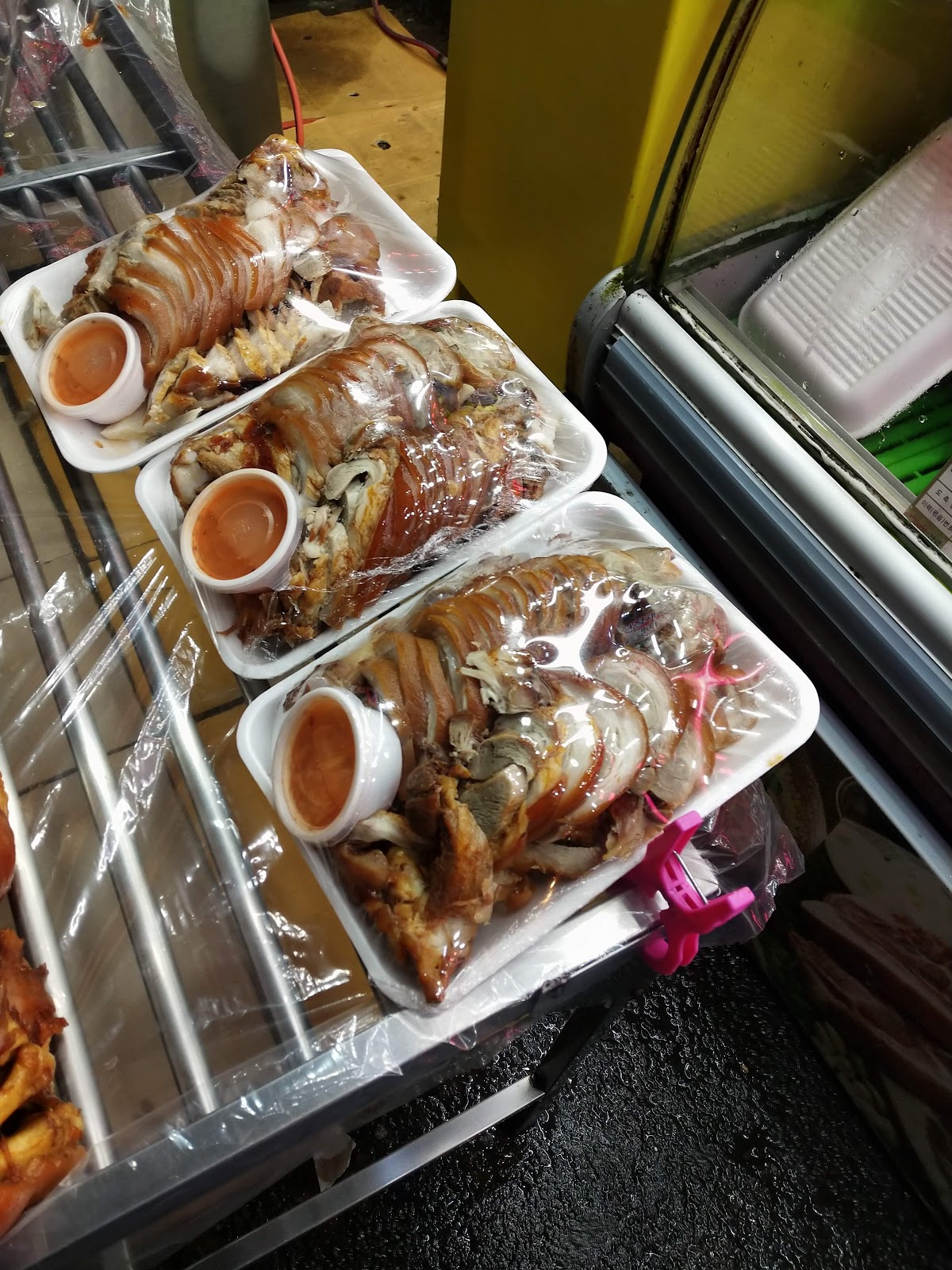
Black Pork at the Dongmun market.
We find a vendor that sells small-ish trays of black pork (big ones go for 10K won, ours is 7K won), and get one such tray.  Then we hit the actual street food vendors. First, is a stall where we buy a crab shell stuffed with crab, cheese, baby shrimp and a few other things, and roasted  with a flame thrower.

Food vendor at the Dongmun Market is working on Olga's stuffed crab.

The second thing we get there is a stick with a bunch of fried things: from crab to chicken, to cheese, to kimchi, to cellophane noodles.


Stuffed Crab
Comparative analysis of stuff on a stick and the legend

We then find another place that sells rice cakes, blood sausage, tempura, and fish cakes. Olga has a few pieces of tempura, while I get a somewhat healthier order of fish cakes - thin strips of fish on a stick (mine were unfortunately removed from the actual stick making them harder to pick up and eat) boiled in water.

At around this time, all hell breaks loose at the conference. The weather we are having has officially been called a typhoon, and the typhoon has successfully grounded all flights to Jeju from three countries (mainland Korea, China and Japan).  The conference organizers are working hard on moving all Monday workshops to Tuesday, because most workshops are lacking presenters. RE Cares, our event, is in a bit of a pickle too. I am in Jeju City, and so are two other co-organizers. But five more are stuck in three different countries, and some already know they are not coming until Monday night or Tuesday morning.  Unlike all other workshops though, our Monday goal is to meet with local stakeholders - it is a large group of college and high school students, who already made their plans for Monday.  So, we decide to buck the trend and run RE Cares on Monday. 

On the way home I text and email frantically at everyone who is here, and everyone who is not. We make some quick decisions. The three of us already here plan to skype at 8pm.  We are also monitoring a few long threads about changes in the schedule (as everyone except for me is also leading some other event at the conference).  In the meantime, it's about 3pm, Olga and I are heading home, and the rain and wind pick up and really get into it.  We arrive to our hotel room soaking wet, shed our clothes, take hot showers, and attack sashimi and pork that we brought home with us.

Eating sashimi at the hotel.
We like sashimi. The black pork is nice, but too fatty, and we have way too much of it.

I get on the laptop and start figuring out what to do on Monday. A plan starts forming. For simplicity, we will run the event precisely as planned, but we do have to replace a few pieces. Around 5:30pm the rain lets up, the wind drops, and there appear some clear skies out west. We get some good news - those of the colleagues and RE Cares co-organizers still planning on taking planes on Sunday board their planes and take off. 

Around the same time, we decide to take a stroll along the promenade and see how long it takes to get from our end to the other end where Ramada, the conference hotel is.

As we get on the promenade, I start taking pictures.

Jeju City - aftermath of the typhoon. 

A police car parked nearby turns on the lights, drives in our direction and stops at the end of the street. Two officers jump out and run towards me. I figure immediately that standing on the promenade (the waves are still occasionally going over) is considered verbotten, and leave the promenade, hoping that I only get a verbal lashing (and thinking to myself that back in Russia this may already be reason enough to be detained, beaten, and convicted for resisting the authorities). The nice police officers gather between them enough English to convey to me exactly that: promenade is not safe, we should get to the street.
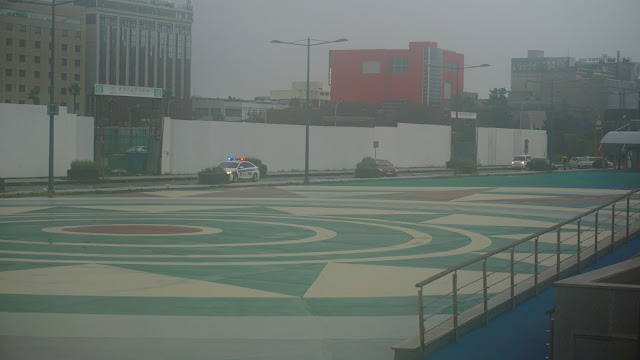

A police vehicle is approaching me.


We leave the promenade, and walk along the street leading from our hotel to Ramada. On the way we discover Antoinette - a somewhat pretentious and expensive coffee/dessert shop (more on it in later posts), Martro - the Costco of South Korea (yeah - actual Costco - they sell Kirkland products there), and E-Mart, a department store, complete with a grocery store underneath it. We buy some food and supplies at Martro and E-mart, head back to the hotel, reach it by around 7:40pm, just in time for me to set up and get ready for the 8pm "So, what are we going to do about tomorrow?" telecon.

At the telecon, we discuss the plans, go over the Monday program, and pep talk each other. By this time some triumphant messages from our colleagues who have landed on Jeju reach us, so the main stress is over.


Sunday, September 29, 2019

Trip to Jeju Day 1: A Very Rainy Day

Korea! We have arrived.
The short flight from Shanghai to Jeju was almost uneventful - except at some point of the trip we got into some sort of an air pocket and got shaken to the core.  Upon arrival things developed reasonably well - bout 45 minute wait at the passport control, then picked up baggage, figured out, with the help of an information desk clerk, where to find the shuttle to the car rental place, and then, finally got into the car rental. All in all - took us about an hour and forty minutes - we arrived around noon local time, and by 1:45 were in the car.

Now, let's name some of the negatives.  The car we got (although we noticed it only later) is an old Kia K3. And by old, I mean, 141000 kilometers (somewhere around 88K miles). It has scratches and dents everywhere, and the idle goes from 500RPM to 1000RPM and back all the time.   That's number one. Also, the free GPS that they supposedly had - all in Korean, so not helpful.

Our somewhat beaten up Kia K3 ready for the trip to start.

Number two: navigation. Per instructions from the car rental place we installed Naver on our phones. It has issues. First, it does not understand street addresses entered in English. Second, it needs wi-fi access to actually set up the maps. There is a way to download maps for off-line use, but in an app that does have nice English UI, the list of maps is in Korean, and figuring out which map is Jeju requires pattern matching skills I, apparently, do not possess.  Olga got the rental place clerk to set the app for us on both phones. 

But these issues pale in comparison to the real problem: it is raining cats and dogs, and then more cats and more dogs.  We arrived in the pouring rain, and the pouring rain isn't going anywhere.  

What to do?

We ask ourselves this question as we sit in the car on the parking lot of the rental place, and go through our options. The listed negatives are all first world problems compared to what could have gone wrong, and - as we found out late - what HAD gone wrong for other people coming to RE'2019. So, we can go to the hotel, but it is just a bit early (check-in is at 3pm), and we feel like if we do check into the hotel, we will  collapse in our room, and there goes Saturday the same way our Friday went.  

So, we ask ourselves: where can we go, where rain is not a concern?  Museum sounds nice, but we don't know much about local museums.  But caves.... Surely, the rain does not affect one's enjoyments of a cave?

And so, we plot the course to Manjanggul Cave, Jeju's largest (and the one most accessible) lava  tube cave.  It takes us about 50 minutes to navigate the streets of Jeju (first, the city, then the island) in the abovementioned pouring rain, and to reach the cave.  Each time we arrive to a new country I am very tentative about driving for the first time - especially in more stressful condition of city driving in inclement weather.  At one point Olga was looking up for me whether Korea has a right turn on read - and gave me the answer to this inquiry ("yes") just as the car behind me started beeping.  

As we made it to the parking lot of the Cave park, the rain, which seemed to almost subside only a few minuted prior, has restarted with new vigor. We got out of the car, got dressed in warm clothes (remembering how quickly the temperature dropped in Iceland's lava tube cave we visited), got the rain jacket on, and grabbed our last snacks from Pudong's "family store". We ate them under the rain on our way (about 400 meters, I think) to the ticket booth. Bought the tickets, and immediately dropped into the mouth of the cave until it was no longer raining, at which point I finally stopped and unpacked the camera.

Manjanggul Cave: the conditions outside.
The cave did not disappoint. Where the cave in Iceland cost around $200 for the four of us to visit, Manjanggul Cave costs around $4 per adult.  Where in Iceland we were on a guided tour, here we get to walk the same distance (about a kilometer in both cases) at our own pace, picking and choosing where to stop and what to do.  Where in Iceland the case is strictly "do not touch", here there are no such prohibitions - even at locations where no one would be surprised if there were.  As a result, we had a very nice tactile experience with various surfaces of the cave.

Manjanggul Cave: a twisting passage.

In the middle of the passage, there is Turtle rock - a lava formation that resembles both a turtle, and the shape of the Jeju Island

Manjanggul Cave: the Turtle Rock.

Further, the cave gets wider and taller and turns into what looks like an underground metro station.

Manjanggul Cave: I am jumping in the air at the "underground station" part of the cave, right before the very last leg.

The terminal end of the passage is capped by a lava column - a hole got punched in the ceiling for the lava tube, and molten lava dripped from the second lava tube located above to form an impressive post.

Manjanggul Cave: the lava column at the end of the passage.

As we walk through along the tube, the walls change from rock, to something covered in stalactites, to the lava layers, like on the picture below.

Manjanggul Cave: layers of lava.

The lighting in the cave is sparse, with some locations getting more light, while others being almost completely dark.


Manjanggul Cave: a passage in the middle of the cave.

The small stalactites forming on the walls and the low ceiling can be touched - there are no restrictions against it in this particular cave, which is very much counter to every other cave we have ever been to.

Manjunggul Cave: the stalactites on the ceiling.
It takes us about an hour to walk the kilometer into the cave and return back. By the time we are out, the rain is catching up, and it is already past 4pm (closer to 5pm, in fact) - the park is starting to get empty.

While the Chinese pastries we ate while rushing to the ticket book did give us strength, we realize that once we reach the hotel, we will crash, and there will not be any dinner after. So, we stop by the restaurant in the park. As any place located inside an attraction, it is probably of questionable quality - too much oriented towards tourists. But we have no options at this point - looking for food on the way home under pouring rain seems quite daunting.  So, we sit at the table, the only customers in a rapidly emptying park, and study the menu that features scant English. Eventually, we settle on sharing a single order of bibambap with an extra bowl of rice, that comes in handy, because our food comes with a bowl of clear broth for each of us (we dunk some of the rice into the broth).

Our first meal in Korea: Bibambap (left) with the sides of broth, and four different types of kim chee.
We start the tradition of taking pictures of our food - which, unlike many other place, we actually successfully continue throughout our entire stay on Jeju.  The first meal comes with four types of kim chi (from right to left): the traditional Napa cabbage one, tiny dried fish (the only time we had this type in a restaurant),  femented/pickled green onion, and a spicy version of daikon kim chi. There is a balance of two chili-based and two non-spicy kim chi offerings.   The food is good - we make quick work of both the kim chi and the bibambap (which turns out to be vegetarian, but it is fine).

Once we are done with the food, we head out to the parking lot, where our car is starting to get really lonely. We carefully drive back into Jeju City, with Naver fortunately working and showing us the way to our hotel.  One concern is hotel parking - this turns out to be a non-issue when we arrive. First, the parking around the hotel is pretty much empty - its raining, an no one is taking advantage of the public plaza behind the hotel, and the  mini amusement park in front of it. Second, as we descend into the basement of the hotel, we get stopped by an attendant, and our car is valet-parked. We get out bags out, ascend the elevator, check in, get a 10th floor room overlooking the harbor (it is in the wing that is orthogonal to the coast - we see a bit of water, the harbor, the fish market underneath the hotel, and the hills behind the harbor), unpack backs, and fall asleep.

We are in South Korea, and the weather aside, so far, so good.


Wednesday, September 25, 2019

Trip To Jeju Day 0: The Friday that was not

Shanghay Pudong Airport: Terminal 1

To say that our departure from home was hectic is to say nothing.  Our flight was at 1:05am on Friday, September 20. We left home at 7:30pm instead of the planned 6pm. The drive down to LA was fortunately uneventful and surprisingly traffic-free, so around 10:30 we were on Century boulevard, where we got gas before driving the rental car to Enterprise.  LAX itself was a mess, the shuttle driver didn't even bother with trying the arrivals level - it was so backed up. The departures level was no better. At 11;05pm we were finally on the arrivals concourse of Bradley terminal, found China Eastern booths, and went through ticketing -  got a nice surprise - our luggage was free to check (I thought I bought tickets with no luggage allowance and was ready to pay), and finally went through security check.  

Things went smoothly from then on. Boarded the plane, and at 1:05am flew to Shanghai.  

This is where we lost our Friday. The flight to Shanghai is 13 hours long, and Shanghai is 16 hours ahead of us. So, 13+16 = 29. We touched down in Shanghai on Saturday, September 21, around 6am local time.  

Transfer in Shanghai was a much less stressful affair than our adventures two years ago when we flew from Melbourne to Lisbon through Xian and Beijing.   Shanghai Pudong concourse is nice, roomy, and was rather empty when we were there. It has a nice "family store" with cheap pastries, and a Chinese Starbucks which sells interesting drinks. The one pictured below is a pomegranate  bubble drink.

Fancy drinks in Chinese Starbucks.
And so, with boarding our flight to Jeju, ended the Friday that we never saw.

Thursday, September 19, 2019

Off to Jeju

Jeju Island must see list

We are about 20 minutes away from leaving the house and heading to LAX, for the first leg of our trip to South Korea's Jeju Island. I will be at the RE Cares'2019 event organized as part of the International Conference on Requirements Engineering (links will be added later).  There will be a couple of days for tourism things as well.

Above is the list of Jeju must-sees and must-haves provided by Aldrin, my former MS student, and his wife, who vacationed on Jeju not so long ago. Let's see how many things we will be able to see/do/check off.

Saturday, September 14, 2019

Peppers

Peppers!

In spring we bought three pepper plants from Home Depot and planted them in the same box. Two plants died. The third one struggled for a bit, then shot up like crazy, then, has gotten so huge that it overturned the box (which fell to the ground from about a meter-high elevation), almost died completely, but not quite, and --- finally, started giving fruit.

This is not the full harvest - there are quite a few more peppers out there, but this is the biggest batch we will collect this year.

Friday, September 13, 2019

Iceland: All the waterfalls...

To finish the Iceland trip theme, let's have a ranked list of the waterfalls we got to see in Iceland.

The list is in the order of my personal preferences.  In some cases, breaking ties was difficult and almost arbitrary.

1. Hraunfossar.  

There are taller waterfalls. There are more powerful waterfalls. There are more impressive waterfalls. But no waterfall we saw in Iceland looked as beautiful to me as the absolutely stunning and highly unusual Hraunfossar waterfalls.


Hraunfossar waterfall: the most beautiful flowing water.

Where other waterfalls are essentially elevation shifts of the riverbed, Hraunfossar is a waterfall where the water rolls into a river from the side - originating, I suspect from the underground of the huge lava field. One picture hardly does justice to the wide variety of ways in which the water rolls down that slope and meets the river, so here are a few close-ups of the most interesting parts.

Hraunfossar: the most complex portion of the waterfalls.

Hraunfossar: the rightmost (most upstream) portion of the falls, with beautiful coloring.

Hraunfossar: somewhat downstream, the more "mundane" part.

2. Glufrabui.  

Probably the second most difficult rank to give (the most difficult is the #3 place) is this one.  At the end of the day, though, Glufrabui wins out simply because of how different it is from everything else. 

Located a few hundred meters away from, and definitely overshadowed by Seljalandsfoss, Glufrabui
might not look like much from the outside: just a thin stream of water falling from the clifftop, and obscured by a large rock in front of it:

From outside, Glufrabui does not look like much.

That is, until you follow the small stream that flows past the rock, and get behind.  There, you find yourself in small space facing gallons of water falling directly on top of you, with an absolutely amazing, and extremely hard to capture light coming through.

Glufrabui: behind the rock.

What really makes it my second favorite waterfall is this sudden change from something totally mundane from afar into this absolutely eerie setting on the "inside".  It just works....

Glufrabui: the path towards the waterfall.
This is one of the few waterfalls we visited, where enterprising individuals can actually walk directly into the waterfall (as one dude did while we were there).


3. Dettifoss.


As I said above, this is the hardest determination to make. There is an almost four-way tie between the four major waterfalls: Dettifoss, Skogafoss, Seljalandsfoss, and Gullfoss, and it is extremely hard to break it.

At the end though, the grittiest of them all, Dettifoss wins it for me.


Dettifoss: the power of falling water.

The tie breaker is the sheer sense of awe I experienced standing mere meters away from the dropoff that is Dettifoss and just looking at that falling water roar past.

It is not a pretty waterfall. The water is rough and tumbling, and it has the color of the lava field around it to  a point where it is almost impossible to tell the river from the banks.

Dettifoss. The sheer power of water.


4. Skogafoss.


The number four spot still has three contenders for it, and Skogafoss wins over Gullfoss and Seljalandfoss in a squeaker.

Skagafoss.

It is a classic waterfall located in an absolutely picturesque setting, with a great views both from the bottom and from the top.

Skagafoss from the top: it IS a long way down.

What is not to like?

5. Gullfoss.


Gullfoss wins this place, because rainbows. Are you kidding me? Just look at those rainbows!

Gullfoss: the waterfall of rainbows

The above is the first photo I took when we got out of the car. It gives some impression of the scale (look at those tiny people next to the top cascade!). It captures a full rainbow (yep, it thins out a bit at the top, but it shines brightly on both sides).

Individual cascades are fun to look at as well.

Gulfoss: the bottom cascade from the side.
 Gullfoss: the top cascade.

6. Seljalandfoss.


In any other country, with any less competition, a waterfall that one can walk around would totally be at the number one spot in the rankings. Because it is really hard to find anything wrong about Seljalandfoss except for the $7 parking fee at the parking lot.

Seljalandfoss.

The ability to actually get behind it makes for some really impressive angles, and adds a layer of respect for the nature for giving us something like this.

While this waterfall looks smaller and less powerful than some of the competition, a close look reveals that this is somewhat deceiving. The water falls in a powerful and loud stream.

Seljalandfoss: on the trail behind the waterfall.

Seljalandfoss: view from behind.

Seljalandfoss: completing the loop.

You will get wet. The camera lens requires constant attention. It is slippery, and colder than elsewhere.  But hard to deny the beauty here.


7. Godafoss. 

This Diamond Circle waterfall is like Niagara Falls in miniature.

Godafoss.

The position of the waterfall makes it very hard to get a good shot (notice how I could not avoid someone's arm when framing - moving would have lost me a significant part of the waterfall itself).
But once you see it all, Godafoss is, indeed, impressive.

8. Selfoss.

Talk about mini-Niagara Falls. This companion to Dettifoss is about 800 meters upstream, and is a beast of different kind - no less powerful, but significantly more refined.

Selfoss.
Getting a better shot than the one above is difficult, as it involves either coming close in order to penetrate that cloud of vapor, or filming from very inconvenient angles.

Selfoss has a rather deep horseshoe shape whose center seems to be persistently clouded.


9. Oxararfoss


Thingvellir's own waterfall. Once again - it is beautiful and does not deserve to be that low, but which waterfall can you bump down for it?

Oxararfoss: on the cliffs of Thingvellir
It is really picturesque, indeed. But not large.


10. Barnafossar.


The companion to Hraunfossar is very different. It is located a couple hundred meters upstream from where Hraunfossar starts, and it is a feisty one.

Barnafossar: the best viewpoint.
The key issue with Barnafossar  is the difficulty of getting a good view of the actual waterfall. The river is narrow and the banks are quite rocky and twisty, and the path does not come too close to the edge. So, there is only one place from which the waterfall can be actually observed.

The rumor has it, this waterfall used to flow right under a natural bridge, but the bridge collapsed, killed children who were standing on it at that moment, and this is how it got its name. The remnants of the natural bridge still can be seen at a close-up.

Barnafossar: the natural bridge.

11. Glanni

Visiting this waterfall was almost an afterthought, and we spent the shortest time of all our waterfall sight seeings there. It is a nice enough landscape, but this waterfall simply lacks the drama of the big ones.

Glanni Waterfall. As calm as waterfalls get in Iceland.


12. Geitafoss


The last named waterfall on the list is just downstream of Godafoss. It is not large, and unfortunately, there is not a good view available - most people probably pass it by and don't even know that it does have a name of its own.

Geitafoss: the best look I could get at it from the side.


And this completes the overview.


When your wine turns 21...

Chateu Latfayette Renau Niagara Mist 1998 vintage.

This is less of a travel report and more of a memory of one that took place over 21 years ago.

In June 1998 my advisor sent me for a month to Ithaca, to spend some time at Cornell, potentially working on some of my thesis problems with Cornell CS faculty. Upon arrival, we learned that Ithaca and Cayuga Lake are a winemaking area. So, on the day before we left to drive Olga back to Maryland (I later took the bus to Ithaca to stay there for that month), we took a drive around the lake, and had our first experience of actual wine tasting.

The context of this is of course the fact that Olga was 5.5 month pregnant at the time. So... she was the designated driver and I was the designated taster.

From that trip we brought back four or five bottles of wine (one per winery, or something like that) - all wines were pretty cheap as I remember. Over time, we drank all of them but this one bottle: Chateau Lafayette Reanau Niagara Mist.  In fact, one of the other wines we got, Goosewatch Diamond was for a long time a favorite of mine, and we were able to procure a few additional bottles on a couple of occasions.

Now, back to  that Chateau Lafayette Reanau bottle.  It survived the two and a half remaining years in Maryland. It survived the move to Kentucky, and a change from an apartment to the house. It survived seven Kentucky years. It survived a trip to California (we packed most of the liquor and wine we had and put it in the container we were shipping - nothing got broken). It then proceeded to survive 12 years and two moves in San Luis Obispo.  As of last week, it was the single oldest bottle of wine in our household (I am somewhat afraid to use the word "collection" here).

Until last Sunday.  We had guests over, and finally - a reason to open it.  The cork, of course,  wound up being broken, and the first glass of wine had to be poured through a strainer.

The wine though...   To be completely honest, I had no recollection what it was supposed to taste like. Given that Olga was not tasting much, and I like sweeter wines, and given that we bought this bottle, it is hardly surprising that the wine was sweet.

But I am pretty sure that 21 years ago this wine did not have this deep dark amber color you can see on the photo above.  I am pretty certain it was not that smooth.   This bottle of $6 wine (we checked the web site - the new vintage is sold for $6.75 - crazy, right?)  tasted like a $50 375ml bottle of a local late harvest wine tastes.

Quite unexpected. But also quite pleasant. 


Diego's Umbrella @ The Siren

While we are preparing for the Korea trip, here is a quick report of  Diego's Umbrella concert at the Siren in Morro Bay, which took place yesterday.  We heard the Umbrellas make the announcement about this concert during their July 12 show on the Plaza in San Luis.

This was the second time we went to The Siren for a Diego's Umbrella concert, and both times it felt like pretty much a friends-and-family kind of event. This time, the crowd was not large, but this was hardly an issue, as after starting with a somewhat unusual to my ear rendition of  Trash Mexican Budapest (my favorite song of theirs), they very quickly got their groove and played a brilliant (as always) show.

Diego's Umbrella: Trash Mexican Budepest


The opening act was  Domestic Tiger, a SLO band that includes a local ex-Umbrella Tyson Maulhardt.  Three guitar front line and all the noise one can expect from it, although from time to time Tyson would let himself go and switch from riffs to solos

Tyson Maulhardt: now with Domestic Tiger.


Some songs reminded me of The Cure. I got a couple of their CDs, which they were giving away, and listened to most of their album Half Life in the car today. I could make out the lyrics and the  music better than at the concert, but overall - same impression.  Now I have to look for their local gig announcements. 

Domestic Tiger: three guitars and all the noise you might expect them to produce.


Diego's Umbrella came without Kevin (they eventually announced from the stage that he just had a baby born), who was replaced by a guitar player whose name I did not catch, but who was presented as "The Bay Area guitar virtuoso". 

Diego's Umbrella: the replacement guitar player.


As a result, I feel like the play list was pared down a bit, filled with individual performances (two by Jason, Jake's spoons, and a couple more), and avoided some of the songs. Vaughan had to sing all parts by himself. They did perform new songs on which Kevin sings lead (Never Take Us Down, and Born to Lead, I think), and, of course, they sang the usual: Bor'ka, Lasers and Lesbians, Queens of Vibration. 

Diego's Umbrella: in the middle of a song.

The full band instrumentals included Swayze and Korobeiniki (which everyone except for us in the audience knew only as "that Tetris song") but - I think for the first time since we started going to their shows - no Hava Nagila.  The lack of the latter did not prevent one lady from the audience from yelling happily from time to time "They are Jewish!" 

Jason's violin number.

Finally, instead of "the one song we do not want to play and you do not want to listen" (per Vaughan), the band presented a scene from their "favorite" movie Team America - starting and ending it with "America, fuck YEAH!"  This was unexpected and quite funny.

Diego's Umbrella performing a scene from Team America.

The bottom line is, despite the somewhat unusual lineup and set list, it was a really fun show. 


Jake Wood and the spoons.

With this, we are starting to slowly switch to the Korea trip that is coming up in exactly one week.